<?xml version="1.0" encoding="utf-8"?><feed xmlns="http://www.w3.org/2005/Atom" ><generator uri="https://jekyllrb.com/" version="3.10.0">Jekyll</generator><link href="http://helaeon.github.io/feed.xml" rel="self" type="application/atom+xml" /><link href="http://helaeon.github.io/" rel="alternate" type="text/html" /><updated>2026-11-03T18:52:44+00:00</updated><id>http://helaeon.github.io/feed.xml</id><title type="html">helaeon updates</title><subtitle>Thoughts from the Void</subtitle><author><name>helaeon</name></author><entry><title type="html">Agriculture</title><link href="http://helaeon.github.io/Agriculture-Plants/" rel="alternate" type="text/html" title="Agriculture" /><published>2026-11-03T00:00:00+00:00</published><updated>2026-11-03T00:00:00+00:00</updated><id>http://helaeon.github.io/Agriculture-Plants</id><content type="html" xml:base="http://helaeon.github.io/Agriculture-Plants/"><![CDATA[<p>Food does not come from “the store”. Food comes from the land. Food comes from people implementing technology to do clever work. Humanity invented agriculture to take control of our food supply and in effect be able to save for the future. In doing so we became insanely productive and resilient. It was no longer necessary to move to find food. With agriculture we could find a good place, settle it, farm it, and invest in building great works and infrastructure. We could stay put to deeply explore and extract the other resources of the land, such as mining. All of which would magnify the production of the people there. Agriculture is the invention that unlocked civilization. The land became massively productive providing more food for more people per acre than ever before. We learned to use selection to make our domesticated plants and animals more productive for our purposes.</p>

<p>People take farming &amp; ranching for granted, especially at scale. Feeding billions of people with a reliable continuous food supply takes engineering, knowledge, intelligence, work, and cooperation. Agriculture was probably the first thing humanity did at scale.</p>

<!--more-->
<p>Being a hunter-gatherer sucks. Subsistence living sucks. You do not get to have the glories of modern civilization without agriculture at scale. Sumerians, Indus Valley People, Olmec, Egyptians, Chinese… all were farming. <a href="https://hms.harvard.edu/news/meet-first-farmers">First Farmers</a></p>

<p>I’m going to throw out some stuff here as I think of it, and I think is interesting that is involved with farming and plant biology. This is in no way all inclusive, or even a tip to a knowledge iceberg. This topic is massive because humanity has a huge incentive to know a lot about agriculture, our very survival on an individual level depends on it. Yet, most people know very little if anything.</p>

<p>Ryan North wrote a humorous book called <a href="https://www.amazon.com/How-Invent-Everything-Survival-Stranded/dp/0735220158/">“How to Invent Everything: A Survival Guide for the Stranded Time Traveler”</a>. This book is a surface primer of how a lot of our technology works, or at least the basic idea. Inventing farming is a major section of the book. But in no way is it an all-inclusive how to.</p>

<p>In “The Martian”, the stranded astronaut is a botanist. If any of the other crew members were stranded instead of Mark Whatney they would have been dead under the same circumstances. His background made it so he had a complete other MacGuyver toolkit available to him that allowed him to survive. We’ll ignore that the Martian soil cannot do what Whatney did because of pervasive perchlorate composition and a reductive environment. <a href="https://www.acityonmars.com/">A City on Mars</a></p>

<p>The foundation of plant agriculture is fertilizer. The rules of chemistry rear their head once again. You cannot create new elements in this context, so in order for plants to make the enzymes and structures they need to live they will need nitrogen to make amino acids. Plants are, by themselves, incapable of breaking the nitrogen triple bond to yield nitrate, nitrite, ammonium. Plants also will use up local sources of phosphorous. If you’re rapidly growing plants and then removing the entirety of their biomass from the field to do it again, so too you remove the nitrogen, phosphorous, and other elements. You need to put it back - fertilizer. In ancient times people would use fish or manure. Today we go maximally efficient with ammonium nitrate (NH<sub>4</sub>NO<sub>3</sub>) and various kinds of phosphate fertilizers.</p>

<p>You must have enough nitrogen present so the plants can build <a href="https://en.wikipedia.org/wiki/RuBisCO">RuBisCO</a>, and other enzymes, to fix carbon dioxide and water into sugar, cellulose, and all of their other biological molecules. Plants need to respire just as you do using oxygen in their mitochondria to burn some of that sugar to make ATP and other energy currency molecules such as NADH and FADH. Giving plants biologically available nitrogen is akin to giving people protein. Fertilizer is where nearly all the nitrogen to make protein in agricultural plants comes from. The major reason for the reduction in protein found in food plants over the last decades is a directed effort to create strains that use less fertilizer, because fertilizer is the main cost of production on a farm. You cannot escape the conservation of matter laws of the Universe. Less fertilizer, less nitrogen, less amino acids, less protein. But, less expensive food and plants more resilient to fertilizer shortages. No solutions, only trade-offs.</p>

<p><a href="https://www.science.org/content/blog-post/nitrogen-ammonia-and-strait-hormuz">As you can imagine fertilizer production and shipping it around the world is a big giant deal.</a>. The <a href="https://en.wikipedia.org/wiki/Haber_process">Haber process</a> is how humanity converts atmospheric nitrogen to ammonium and nitrate (through further processing). N<sub>2</sub> gas, hydrogen, and finely ground iron plus a lot of heat and pressure. You can also use a slight variation of the process where your inputs are water, methane, and atmospheric nitrogen. Yes the chemist that gave us mustard gas, weaponized chlorine gas, and had a lust for chemical weapons during World War 1 also gave us a key technology to feed a lot more people. I cannot overstate how important the Haber process is to agriculture and modern civilization. People think “food comes from the store” and this is a big reason why. It’s also worth looking into <a href="https://en.wikipedia.org/wiki/Carl_Bosch">Carl Bosch</a> if you want to know more about the kind of industrial chemistry that makes our world possible. Nobel Prizes to both for their parts in this work. Haber for inventing it in the first place and Bosch for making it industrially efficient.</p>

<p>Various microbes can fix nitrogen from the atmosphere to help, but it’s never enough or fast enough (at our current level of knowledge and technique). Field rotation, which is a key technology, partially works on fostering funguses and microbes in order to fertilize the soil by the varying kinds of plants to increase productivity overall. There are nutrients beyond nitrogen that are of concern, and different plant species absorb and excrete different nutrients. What plants to rotate on what fields, in what order, and which combinations for sale in the right seasons such the field is always profitable depends on a great number of factors. <a href="https://www.nrcs.usda.gov/sites/default/files/2023-01/Rotations%20for%20Soil%20Fertility-%20Small%20Scale%20Solutions%20for%20your%20Farm.pdf">Here’s a USDA PDF on the practice</a> and a <a href="https://www.ars.usda.gov/plains-area/mandan-nd/ngprl/docs/crop-sequence-calculator/">crop sequence calculator from USDA for the Northern Great Plains</a>. You’re not doing this alone though you will still need fertilizer made by the Haber Process. “Natural” and “Organic” farming is mostly crunchy hippie nonsense for people with enough money that efficiency doesn’t matter to them and the burden of maintaining a stable food supply falls on someone else. It’s marketing mostly, not a practical way to feed people at scale.</p>

<p><a href="https://en.wikipedia.org/wiki/Cereal">Cereal grains</a> are the group of plants at the heart of civilization. Starting to utilize grasses and eventually cultivate and domesticate them was the invention of farming. The plants we eat regularly today have all been altered by us to be better food sources for us. They are in no way even kind of like the plants our ancestors 20,000 years ago knew. Some of them didn’t even exist. Such as all of the variety of plants we made from the <a href="https://en.wikipedia.org/wiki/Brassica_oleracea">wild cabbage</a>. Some didn’t exist at all until after the 1920s when <a href="https://www.sciencefocus.com/science/what-is-radiation-breeding">gamma ray bombardment to induce genetic mutation</a> was used to create cultivars such as various strains of rice, wheat, &amp; barley, the star ruby grapefruit, and a couple thousand more. <a href="https://nucleus.iaea.org/sites/mvd/SitePages/Home.aspx">Mutant Variety Database</a> is pretty amazing. There’s a database on there you can search by all kinds of different categories such as radiation source, type of plant, the trait improved. Keep in mind some of the traits improved are the sorts of things that make feeding billions of people possible. None of these are considered GMO or require that label even though they very, very much are.</p>

<p>Some grasses evolved the <a href="https://en.wikipedia.org/wiki/C4_carbon_fixation">C4 carbon fixation system</a> to make up for some massive inefficiencies in RuBisCo. See… RuBisCo in the presence of O<sub>2</sub> can literally become jammed and the enzyme must be destroyed in order to recover. RuBisCo isolated away from the oxygen it is producing would lead to a massive increase in efficiency. This is what C4 grasses have evolved. <a href="https://pmc.ncbi.nlm.nih.gov/articles/PMC7065233/">Rice is not a C4 plant, but its relatives are, there’s a major initiative to engineer C4 Rice which could increase food crop yields by 50%.</a> Corn, sorghum, and millet are C4 crops. This is the sort of thing humanity invents in agriculture to feed more people, better. When you’re anti-GMO this is the sort of thing you’re against. And <a href="https://en.wikipedia.org/wiki/Golden_rice">Golden Rice</a>. Gene insertion is a lot like the radiological and mutation methods described above, but with complete known working genes &amp; proteins, rather than inducing a random mutation and seeing what happens or selectively breeding for decades to centuries.</p>

<p>Here’s another big freaking deal <a href="https://asm.org/articles/2024/june/beyond-endosymbiosis-discovering-first-nitroplast">the discovery of the nitroplast in Braarudosphaera bigelowii</a> and <a href="https://www.science.org/doi/10.1126/science.adk1075">the actual paper</a>. An organelle in a eukaryote, that lives in an oxygenated environment that cracks N<sub>2</sub> into biologically relevant molecules. Now, would growing algae that are fixing their own nitrogen, or transplanting the nitroplast into other plants (GMO again!) be more efficient in creating enough nitrogen to rapidly grow plants for food? Maybe. Still, more knowledge and options is always good. Either way, more food, more nutrients, fewer crop failures, for less input/cost. That’s what GMO does. Being against GMO is being against that and failing to understand that every single crop that we use today is a GMO. Every. Single. One. The criticisms that land are mostly about Monsanto and trying to patent life while suing farmers. It’s not really about genetic technology or safety, other than some feelings that fall into the <a href="https://news.immunologic.org/p/the-appeal-to-nature-fallacy-is-the">appeal to nature fallacy</a>, and an assumption that natural is safe &amp; healthy. Let me introduce you to some natural products that will mess you up <a href="https://en.wikipedia.org/wiki/Strychnine">strychnine found in certain seeds and tree nuts</a>, <a href="https://en.wikipedia.org/wiki/Cyanide">cyanide - almonds, cassava root, lima beans, apples, apricots</a>, <a href="https://en.wikipedia.org/wiki/Tetrodotoxin">tetrodotoxin - octopus, pufferfish, crabs, toads &amp; frogs</a>, <a href="https://en.wikipedia.org/wiki/Ricin">ricin - castor beans</a>. That list is in no way all inclusive.</p>

<p>The vast, vast majority of our food plants are angiosperms. As in, flowering plants, a clade that arose during the Cretaceous (the last age of the dinosaurs), and has since taken over the world. That’s right stegosaurus (Jurassic) predates grass. There were no grasses anywhere on Earth when stegosaurus was alive. No flowers, no wild cabbages. Consider how very different that world would be. Anything that flowers did not exist. <a href="https://www.museumoftheearth.org/bees/evolution-fossil-record">Heck, there weren’t even really bees as we know them because bees as we know them today are co-evolved with flowering plants.</a>. An earlier draft I had that that no dinosaur ate fruit, because fruit did not exist. However, it did at the end of the Cretaceous and we found a dinosaur that ate it <a href="https://www.science.org/content/article/first-dinos-only-ate-fruit-munched-parrots">Hell Chicken</a>.</p>]]></content><author><name>helaeon</name></author><category term="The World" /><summary type="html"><![CDATA[Food does not come from “the store”. Food comes from the land. Food comes from people implementing technology to do clever work. Humanity invented agriculture to take control of our food supply and in effect be able to save for the future. In doing so we became insanely productive and resilient. It was no longer necessary to move to find food. With agriculture we could find a good place, settle it, farm it, and invest in building great works and infrastructure. We could stay put to deeply explore and extract the other resources of the land, such as mining. All of which would magnify the production of the people there. Agriculture is the invention that unlocked civilization. The land became massively productive providing more food for more people per acre than ever before. We learned to use selection to make our domesticated plants and animals more productive for our purposes. People take farming &amp; ranching for granted, especially at scale. Feeding billions of people with a reliable continuous food supply takes engineering, knowledge, intelligence, work, and cooperation. Agriculture was probably the first thing humanity did at scale.]]></summary></entry><entry><title type="html">Units &amp;amp; Constants</title><link href="http://helaeon.github.io/units-constants/" rel="alternate" type="text/html" title="Units &amp;amp; Constants" /><published>2026-06-15T00:00:00+00:00</published><updated>2026-06-15T00:00:00+00:00</updated><id>http://helaeon.github.io/units-constants</id><content type="html" xml:base="http://helaeon.github.io/units-constants/"><![CDATA[<p>Did you know that all of our units in science are defined by measurements of nature? Each and every one of them is determined or determinable by measuring a specific thing? <a href="https://www.nist.gov/si-redefinition/turning-point-humanity-redefining-worlds-measurement-system">All of our official units of measurement are now defined by the constants of nature.</a> This is work that was finished and agreed upon very recently. I do encourage you to click that link and read the NIST page about the units, their history, and the constants. It’s extremely well done.</p>

<p>An aside: <a href="https://www.nist.gov/topics">NIST</a> is a great example of a benevolent government agency. A lot of things we absolutely take for granted are enabled by NIST and we don’t think about it or them at all because they do it so well. NIST makes it such you don’t have to trust something you can prove it and know the reference you received from NIST is the genuine article and will be backed up by the force of law. This is how insanely important units and standards are.</p>

<!--more-->
<h2 id="constants-of-nature">Constants of Nature</h2>
<p>From the constants c (speed of light), h (Planck’s Constant), e (elementary charge), ∆νCs (Hyperfine transition of Cesium-133), k (Boltzmann Constant), N~A~ (Avogadro’s Number), K~cd~ (Luminous Efficacy Constant), all of our units of measure can be determined anywhere in the Universe. Use the link above if you want to know what all of them are and what they mean.</p>

<p>For example the meter is defined by the distance a photon covers in a perfect vacuum in 1/299,792,458 of a second. Second is a unit too so that must be derived from nature. That’s what the hyperfine transition is for, that determines the value of a second.</p>

<p><a href="https://physics.nist.gov/cuu/Constants/index.html">There are other constants of nature not mentioned here</a> that are very important, such as the dimensionless constants. Most famous is probably the <a href="https://physics.nist.gov/cuu/Constants/alpha.html">fine structure constant α</a> which is approximately 1/137.035999177. <a href="https://www.youtube.com/watch?v=RCSSgxV9qNw">1/137 and it shows up everywhere in quantum mechanics and fundamental equations</a>. This constant quantifies the strength of the electromagnetic interaction between elementary charged particles, the force carrying particle of which is… the photon (light).</p>

<p>Dimensionless constants are special because no matter what unit of measurement you use if you faithfully plug the measurements into the defining formula the units all cancel out. This means that as long as the values were measured well in the correct unit the final number will always be the same as the relationship between those numbers is the same. Whether you are Eridian, Vulcan, Turian, or Human you know the fine structure constant as about 1/137.</p>

<h2 id="dimensional-analysis">Dimensional Analysis</h2>
<p>Probably the most powerful thing I learned in Chemistry &amp; Physics is <a href="https://www.explainxkcd.com/wiki/index.php/687:_Dimensional_Analysis">dimensional analysis</a>. You do math on the units themselves as you run the equation, and doing so you check your work. This is why your science teacher was so nutty about including the units. Had we been clued in on this in Middle and High School you too would have been much more conscientious of your units! Using this technique you know if you’re missing something or you failed to do a conversion somewhere. Doing actual physics it gives hints of constants you may need, missing variables, important (or irrelevant) relationships.</p>

<p>You may do a calculation and get out the back side inch seconds per milliliter, which is a goofy unit. Certainly not a Joule (kg × m^2^ /s^2^).  Maybe you need to do a conversion somewhere (yes for sure), or you put in a wrong measurement somewhere so it didn’t cancel out. <a href="https://what-if.xkcd.com/11/">Here’s a genuine what-if starting with dimensional analysis - there are actually lots of xkcd what-ifs with dimensional analysis</a> and <a href="https://what-if.xkcd.com/84/">Fermi Estimation</a></p>

<p>E=mc^2^ is Joules equals kilograms times speed of light in meters per second squared. If you put in daltons instead of kilograms you’d get (dalton × m^2^ /s^2^), not Joules. Knowing dimensional analysis you need kilograms/dalton to get the answer in joules. 1.66054 x 10^-27^ kg / dalton. Multiply your answer by that, and you have your answer in Joules because you canceled out dalton and left kilograms in its place! You could transform E=mc^2^ with a conversion constant to get it to pop out any units you want and use whatever units you want and it would still be correct. Yes you could have E be BTUs, m be pounds on earth, and c be in miles per hour. Our units are arbitrary their relationships are not.</p>

<h2 id="planck-units">Planck Units</h2>
<p>We backed into calculable units such they were close to our historical units that we were used to. As in the numbers our instruments were already set up to kick out. <a href="https://simple.wikipedia.org/wiki/Planck_units">What if one set up the equations and constants of nature such that the most fundamental equaled 1?</a> Plank had this idea in 1899 and it actually simplifies things quite a bit. Speed of light is 1 plank length divided by 1 plank time for example. G is 1 rather than 6.67430×10^−11^ Nm^2^/kg^2^. <a href="https://www.youtube.com/watch?v=ZR-1Jol_nUM">Sabine Hossenfelder on this concept of no units</a> It’s really a fantastic video and you should watch it.</p>

<h2 id="cursed-units">Cursed Units</h2>
<p><a href="https://www.youtube.com/watch?v=kkfIXUjkYqE">Sometimes bonkers things come out of units. Either by history, convention, or lazy labelling</a>. There are 3 of these videos. They’re all pretty great.</p>

<h2 id="conclusion">Conclusion</h2>
<p>Consider this the other way… all of these units &amp; constants relate directly to the laws they are involved in. Things we can touch, measure, experience, design, use. They actually are fundamental to the Universe and what makes it up. Magic needs these constants to be different, or be variable - not constant. In doing so you alter the very physical laws that keep the Universe ticking. There are <em>consequences</em> to these constants being something different anywhere, ever. You couldn’t hide the evidence it was done, unless it in fact destroys the Universe itself in doing so such there are no witnesses. But then, you wouldn’t be here reading this… Proof it didn’t because it can’t.</p>]]></content><author><name>helaeon</name></author><category term="The World" /><summary type="html"><![CDATA[Did you know that all of our units in science are defined by measurements of nature? Each and every one of them is determined or determinable by measuring a specific thing? All of our official units of measurement are now defined by the constants of nature. This is work that was finished and agreed upon very recently. I do encourage you to click that link and read the NIST page about the units, their history, and the constants. It’s extremely well done. An aside: NIST is a great example of a benevolent government agency. A lot of things we absolutely take for granted are enabled by NIST and we don’t think about it or them at all because they do it so well. NIST makes it such you don’t have to trust something you can prove it and know the reference you received from NIST is the genuine article and will be backed up by the force of law. This is how insanely important units and standards are.]]></summary></entry><entry><title type="html">What If - The Flood</title><link href="http://helaeon.github.io/what-if-the-flood/" rel="alternate" type="text/html" title="What If - The Flood" /><published>2026-05-14T00:00:00+00:00</published><updated>2026-05-14T00:00:00+00:00</updated><id>http://helaeon.github.io/what-if-the-flood</id><content type="html" xml:base="http://helaeon.github.io/what-if-the-flood/"><![CDATA[<h2 id="what-if-noahs-flood-literally-covered-the-entire-world-to-cover-the-highest-of-the-high-mountains">What if Noah’s flood literally covered the entire world to cover the highest of the high mountains?</h2>

<p>15 cubits above the “mountains”. 22.5 feet. About 7m. Some readings are “highest of high mountains”. Everest is 8850m. So 8857m.</p>

<p>In hebrew it’s <em>har</em> which can be used for “hill country” or just “mount”. That could suggest a regional flood of the Black Sea. The word for Earth, <em>eres</em>, can mean simply “land”. It was their world, for all they knew it was everything, but it wasn’t literally the entire Earth. That would be reasonable though. There is evidence to support it that complies with physics, actually it’s evidence because of physics.</p>

<p>This will all be in metric, generally, because all of the formulas and units are in metric. The math is painful enough with the orders of magnitude being what they are, we don’t need to induce mistakes through unnecessary unit conversions. The units I choose to use will be for that purpose. A large amount of what’s being done here is unit conversions using natural constants, understood physical formulas, and things we’ve directly measured. None of this is so wild it’s on the vanguard of physics.</p>

<!--more-->

<h3 id="is-there-enough-water-on-earth-to-do-a-worldwide-flood">Is there enough water on Earth to do a worldwide flood?</h3>
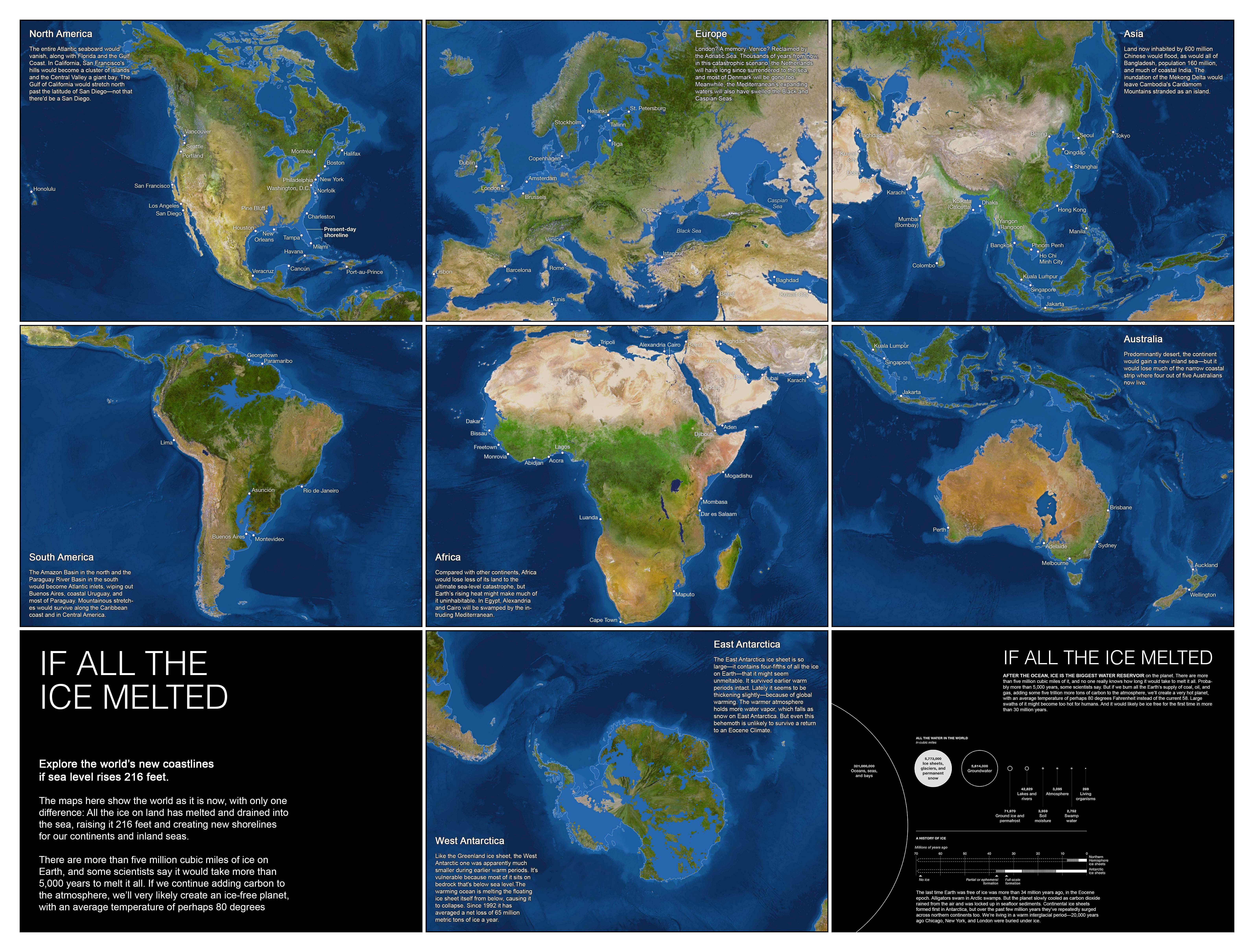
<p><img src="https://helaeon.github.io/images/flood/alltheicemelted.jpg" alt="If all the Ice Melted" title="If all the Ice Melted" />
That’s pretty much all of the water available on Earth. 66m of sea level rise across the whole planet. I like hostile information. We have here a group incentivized to doomsday the worst possible scenario for world-wide flooding. They’re going to find absolutely ALL the water available to make their point. This is exactly the information I want, just… not for their purpose. Which is what makes it perfect. That lower right square has a nice breakdown of what’s available and where.</p>

<h3 id="how-much-water-is-necessary-to-cover-all-of-earth-to-everest--7m">How much water is necessary to cover all of earth to Everest + 7m?</h3>

<p>We already have the world filled up to sea level, so we don’t need to worry about that.
Radius of the earth is 6371000m. Volume of a sphere formula is 4/3 π r^3^. Then repeat with + 8857. 1.08770x10^21^ m^3^ - 1.08321x10^21^ m^3^ = 4.59x10^18^ m^3^ of volume that must be filled. That’s <strong>4.59x10^21^ L</strong> . Bolded because that number is getting used a lot. 1 liter of water is also 1 kilogram.
We also should consider the terrain isn’t flat, we don’t actually need to fill that entire volume. The above sea level rock volume is about 8 x 10^8^ L. The way exponent math works the first digit that would be 13 places to the right of the decimal point and we’re working with only 3 significant figures here. That 9 does not change to an 8. If you think about it this makes sense. Commercial aircraft cruise at 9400m-11600m. Most of what’s below you at all times is a lot of air. Now… that’s all water. Note that low altitude is about 1km above our new surface level. About half a mile. We’re filling up the Earth to nearly aircraft cruising height. Contemplate that scale for a minute.</p>

<p>6.37x10^6^m is the <em>mean</em> radius of Earth. That’s calculated as mean of sea level at poles vs sea level equatorially. The Earth is an oblong spheroid, not really a perfect sphere. To simplify things for a calculation like this the mean is the correct value to use. Calculating the shell to get the exact precise number won’t change the magnitude of what’s going to happen here.</p>

<p>Mass of Earth is 5.97x10^24^ kg, 10^21^ is trivial enough so doesn’t change gravitation or orbit of moon. It does budge g (9.8 m/s^2^) but not enough to matter. I did calculate this and depending on how you approach it, the added radius cancels out the additional mass or it increases g on the surface of the earth by 0.03 m/s^2^. The variance of g across the surface of the Earth due to changes in density and lumpiness is about that much and none of us notice that.
<a href="https://en.wikipedia.org/wiki/Gravity_of_Earth">Wikipedia Gravity of Earth</a> There’s a nice gravity map from the GRACE mission on there.</p>

<h3 id="lets-make-it-rain-40-days-and-40-nights">Let’s make it rain! 40 days and 40 nights!</h3>

<p>8860m of rainfall over the next 960 hours over the entire surface of the earth will need to accumulate.  9.230 m of rain per hour. A violent shower is 50mm per hour, this is 9230mm per hour. 185x greater. The heaviest rainfall ever measured was 400mm per hour during cyclones, this is 23 times that.</p>

<p>9.230 meters of water needs to accumulate on every square meter of the surface every hour, so 9.230 m^3^/hr. There is 1000 L per m^3^ for 9230 L/hr. 1hr is 60min is 1min/60sec so 2.59 L/sec. One liter of water is 1 kilogram so 2.59 kg/sec falling on every square meter of the Earth’s surface.  A water balloon weighs about 50g, so 51-52 water balloons hitting every second, everywhere on Earth. Large drops tend to break up into smaller drops that move slower, so that might make it marginally better as they’ll likely be regular giant drops but 23x as dense coming through that volume of space as anyone on Earth has ever experienced. Good news is it’s only about 0.2% of the volume of every cubic meter of air so it’s not completely displacing the atmosphere all at once.</p>

<p>Having the rain fall evenly over the entire surface is the best case scenario. If we were to dry up sections the rate of fall has to increase elsewhere to make up for where it was lost somewhere else. We’re already at 23x the worst rainfall flux that has ever been recorded.</p>

<h3 id="thats-pretty-extreme-but-doesnt-seem-impossible">That’s pretty extreme but doesn’t seem impossible…</h3>

<p>So, there are <strong><em>consequences</em></strong> to all of this. Physical bills that must be paid. Energy and matter that must be accounted for. Unintended side effects due to the laws of nature. Natural observed phenomenon will be considered. Key is the scales involved most people (nearly all) have absolutely no reference frame for. Our planet is difficult to comprehend large with unimaginable amounts of mass when compared to the scale of a human, or even all of the people on Earth (also has become a difficult to contemplate number). 10^21^ is every person on Earth (10^9^) having the entire budget of the United States government (10^12^). 10^21^ seconds is 10 thousand times (10^4^) longer than the Earth has existed (10^17^). That is, the entire history of Earth… 10 thousand times. Scale. On the scale of the Solar System the Earth is nothing. On the scale of the Milky Way, not even a grain of sand (the Sun itself barely qualifies)… yet… the Earth alone is difficult to comprehend large.</p>

<p>The slice on which you live is incredibly small. The slice of energies you can survive not even a puff as far as the Universe, or even a planet is concerned. The planet winks and you die. The temperature range you can survive is incredibly narrow. You get about 250°K to 325°K in a Universe that operates 4°K to 30,000°K and beyond. <a href="https://waitbutwhy.com/2020/09/universe.html">Scale of The Universe</a> - <a href="https://www.youtube.com/watch?v=3mnSDifDSxQ">The Largest Star in the Universe Kurzgesagt</a></p>

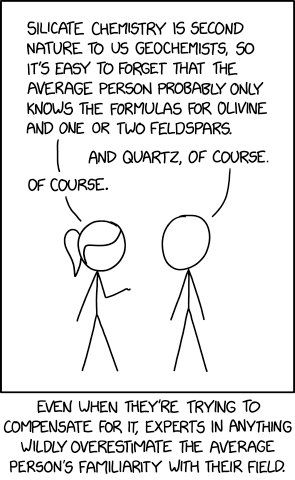
<p>Note too there is a relevant <a href="https://xkcd.com/2501/">XKCD (2501)</a></p>

<p><img src="https://imgs.xkcd.com/comics/average_familiarity.png" alt="Average Familiarity" /></p>

<p>I know a lot about a variety of scientific fields and physical phenomenon. I easily forget that this isn’t typical or even normal. Knowing that the mass of a molecule reduces ever so slightly when energy is released during a reaction. Anything with temperature glows. That glows includes radio waves, microwave, infrared, x-rays, gamma rays; because its all light. That all materials have a specific value of how much energy it takes to raise its temperature 1°C. For liquid water it’s 4.184 J/g and it’s different for vapor and ice. And that it’s incredibly high, as most metals are around 0.4 J/g. All of the below are things like that. To me they are very normal and I think everyone knows them or has been exposed to them. For most people, this might be the first time they’re hearing of any of it. All of these things can be looked up and are explained in exquisite detail written by people who know even more about it.</p>

<h3 id="where-does-all-the-water-to-come-from">Where does all the water to come from?</h3>

<p>There is only 2.39x10^19^ kg in the ice caps to use. That’s pretty much all of the available water on Earth available to use for this purpose. Leaving 4.56x10^21^ kg to come from somewhere.</p>

<h3 id="option-a---create-it-out-of-thin-air">Option A - Create it out of “thin air”</h3>

<p>E=mc^2^ says we can create matter from energy, to make 4.56x10^21^ kg of water. 4.56x10^21^ x (3.00x10^8^) ^2^ = 4.10x10^38^ J total minimum as it assumes a perfect 1:1 conversion ratio. 960 hours to make it (3.46x10^6^ seconds), 1.18x10^32^ J/sec (Watt). The sun puts out 3.86x10^26^ watts, so, we’re going to need a much bigger star and then Dyson sphere it. You would need a spectral class B star, 3-4 times the mass of our sun. That… will mess with the planetary orbits quite severely… (I’m not going to calculate that). That mass also needs to come from somewhere. Not even getting into once you’re done with the mass energy conversion what that extra star’s output will do to rise the temperature of the surface of the Earth. One could make all that water at a B class star and bring it here through interplanetary space. Regulus is the nearest one at 79 light years away. Maybe you could borrow it for a bit and drop that ice ball on the Earth… that’ll be a big hit as the trajectory will be hyperbolic in reference to the sun. You could use just about any star at that point as you’d have all the time you needed to make the mass of water then deliver it through interplanetary space at the correct time, but still have that hyperbolic orbit problem. This is also assuming you’d be using the energy of that star to fuel the energy input needed to eject your water-ice ball out of your originating system to send it to ours. I guess you could get really kerbal with it and basically make some kind of ice ship that elegantly shows down in orbit to deliver the water as gently as possible (below)… but understand you’re doing ancient aliens here.</p>

<p>I should note that humans don’t know how to do 1:1 energy to matter conversion. <a href="https://www.fnal.gov/pub/science/inquiring/questions/jackie.html">Closest we get is the production of anti-matter.</a></p>

<h3 id="option-b---comets">Option B - Comets</h3>

<p>The other way to get that much water is to drop comets from the Oort cloud. Understand when I say “drop” I mean it quite literally. The entire Sol system is a big hill with Sol at the bottom and each of the planets as a divot. If you slow something out of its orbit it literally falls just as dropping a ball from your hand. Except the ground is the Sun and there’s no friction.</p>

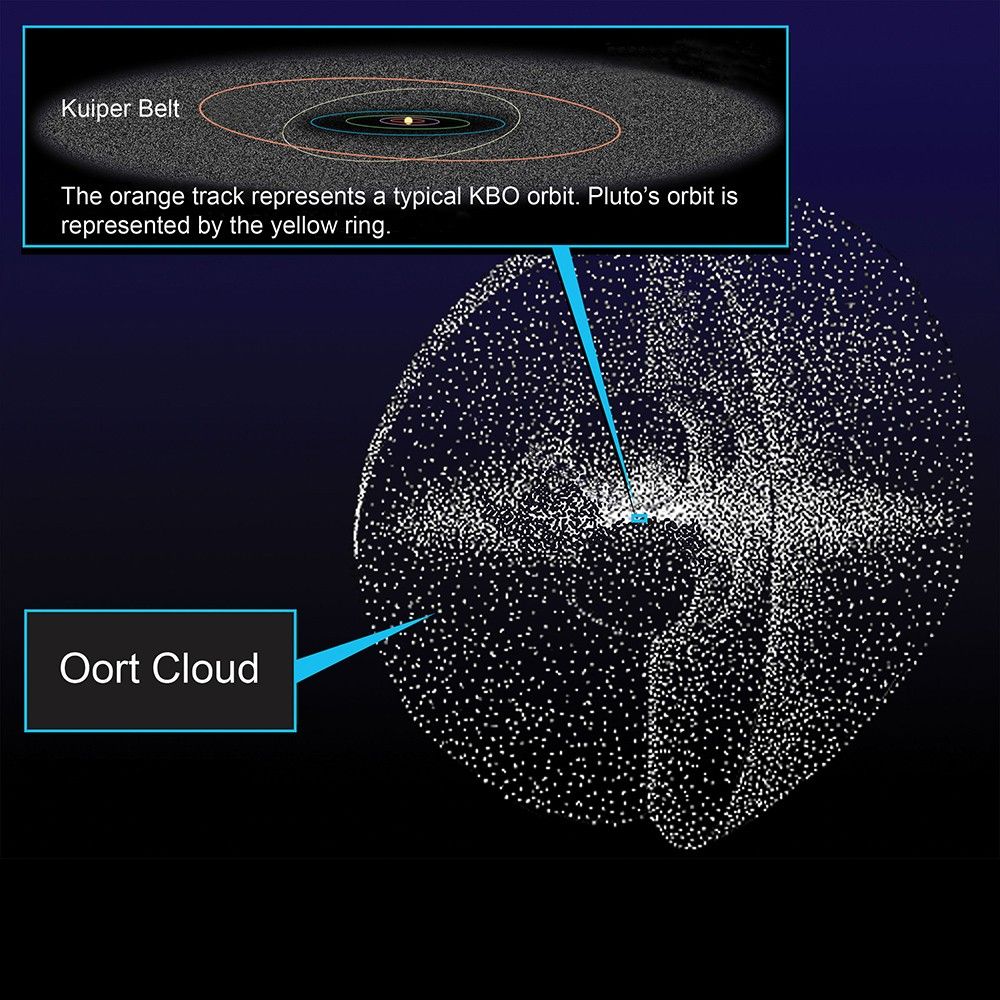
<p>We will need to bring in sufficient number comets from beyond the orbit of the Kuiper Belt (Pluto’s orbit) to Earth to all arrive in that 40 day window. Not raining torrential rain drops, raining comets. Adjusting “high” orbits is pretty easy as far as rocket science goes. The orbital velocity far away from the gravitation center is slow, little changes in an orbital velocity vector has a huge effect on orbital parameters. The average Oort cloud comet is estimated to weigh 4x10^12^ kg. I initially considered transferring Saturn’s Rings (10^19^ kg), but there’s not enough ice there. The total mass of the Oort cloud is estimated to be at least a full earth mass (10^24^), up to 100 earth masses. Some estimates say there’s on the order of billions of comets (10^9^) and we need 10^21^kg. 12+9 is 21 so on those low ends we’ll be using most of the Oort Cloud. <img src="https://assets.science.nasa.gov/dynamicimage/assets/science/psd/solar/2023/09/o/OortCloud1000w.jpg?w=1000&amp;h=1000&amp;fit=clip&amp;crop=faces%2Cfocalpoint" alt="Oort Cloud-Sphere" /></p>
<p><img src="https://upload.wikimedia.org/wikipedia/commons/d/da/PIA17046_-_Voyager_1_Goes_Interstellar.jpg" alt="Oort cloud-Scale" title="http://by%20nasa%20/%20JPL-Caltech%20-%20http://photojournal.jpl.nasa.gov/catalog/PIA17046,%20Public%20Domain,%20https://commons.wikimedia.org/w/index.php?curid=28366203" /></p>

<p>This average comet would be about 2km in diameter.  Comets vary in their composition, but we’re going maximum charitable and saying that 100% of it is ice. It’s not. The size variance between comets will matter more. So averages. But it’s not going to matter much here and makes it worse… you’ll see. Dropping comets all in the same 40 days, provided you have time to set it up and years for the comets to make it in is astrophysics calculations. There’s many many ways to nudge those comets.</p>

<p>The Oort cloud is 2,000 to 100,000 AU (1 AU is the average mean distance between Earth &amp; Sol). Our best case velocity will be one coming in from 2000 AU, arriving in plane, and will ever so slightly kiss Earth’s orbit at periapsis when the Earth is there… at 42.01 km/s, Earth is orbiting the Sun at 29.79 km/s. Delta of 13kms. Turns out no matter where you drop from in the Oort cloud the periapsis will sit at about 42 km/s. What changes is how much of the orbital velocity of the comet you need to cancel out in the cloud, it’s 200-400m/s. Note I’m assuming you’ll be able to find enough comets to arrive them in this best case way over the course of 40 days. I’m also completely ignoring the energy &amp; reaction mass required to delete 200-400m/s of velocity from a billion ton object, and do that a billion times. Note it’s going to take years to decades for these comets to arrive. Once this course of events is set in motion it cannot be stopped. <a href="https://www.satsig.net/orbit-research/elliptical-orbit-height-and-speed.htm">Orbit height and speed calculator</a></p>

<p>If the comet is out of plane (nearly all are), or need to arrive at a time other than the comet’s periapsis you’ll get closer to or possibly exceed that 42 km/s. Our best case has us at 3.38x10^20^ J of collision energy. The little boy dropped on Hiroshima was 6.3x10^13^ J. This single strike is 10 million times more energetic than that. The biggest nuclear weapon ever, Tsar Bomba, was 2.1x10^17^ J, this is 1000 of those all at once. The asteroid that wiped out the dinosaurs is estimated at 1x10^23^J, we’re 1000 times less bad than that - so good news there, except we need to do it a billion times over 40 days to get the amount of water we need. 290 of these strikes somewhere on Earth every second for the entirety of these 40 days. If 42km/s you go to 3.5x10^23^J, so now we’re at 3x what killed off the dinosaurs - for one collision. We could use smaller sized comets so atmospheric heating would disperse them some more before they strike, could even aerobrake them and bring them in over time, but that won’t happen over a month. <a href="https://www.omnicalculator.com/physics/impact-energy">Impact Energy Calculator</a></p>

<p>Because we’re bringing in billions to hundreds of billions of comets in a short time we’d heat the atmosphere incredibly. Remember the energy of the high part of the comet’s orbit has to go somewhere. In this case, it’s our atmosphere and the rocks or water the comet impacts. It’s the sort of event that would absolutely be noticed. The last time around this much water was delivered to Earth by comets, over a much much longer period of time (hundreds of millions of years - <a href="https://science.nasa.gov/moon/lunar-craters/what-is-the-late-heavy-bombardment/">The late heavy bombardment 4 billion years ago</a>, it kept the Earth entirely molten until the deliveries ceased. This would change our initial calculations for how much water we need as the surface of the Earth would look very different after this was finished… and molten.</p>

<h3 id="option-b-two---comets-destroyed-into-a-perfect-tubular-ice-cloud-exactly-in-the-way-of-earth-to-get-this-done">Option B Two - Comets destroyed into a perfect tubular ice cloud exactly in the way of Earth to get this done</h3>
<p>Even if performed in the most elegant way possible… say setting up a wall of comet tail debris such as the Earth plowed through it and picked up all the water necessary, you’d still have crazy meteor showers for the entire duration as… comets aren’t 100% water and the Earth would be plowing through a billion, trillion kg of water-ice. The shape of the ice field is extremely improbable and we’re glossing over the fact of how it arrived at this place, with what energies, and by what process. The energy of those collisions still applies. You may also be turning the atmosphere to a plasma. The Earth needs to acquire 4.78x10^18^ kg of water per hour, 1.34x10^15^ kg/second. This scenario is like we’re doing an atmospheric entry but with the Earth itself.</p>

<p>The Earth orbits at 29790 m/s so our 1.34x10^15^ kg of ice would need to be spread out over a volume of 3.80x10^18^ m^3^. This yields a density of 3.52x10^-7^ g/cm^3^. At far far less than .94 g/cm^3^ it means we’re not hitting a solid wall of ice. Just wanted to make sure.</p>

<p>The atmosphere still heats due to this flux of matter colliding with it. Downside to doing the calculation of water accumulation this way means that you have the full 29.79 km/s delta with all that ice. <a href="https://www.purdue.edu/impactearth/">Perdue’s Impact Calculator</a> is saying a projectile with the diameter of the Earth, with the density of our cloud, at a 90 degree angle, doing 30km/s will have 1.72x10^27^ J of energy. That’s happening every second. Neat part about their calculator is it’s on a slider so even if I drop it to 11 km/s it only helps by a single order of magnitude same if one moves the angles. The problem is the amount of matter! Every second means that joules is actually watts. The Earth’s surface receives 1.73x10^17^ W from the Sun over the same area. This is 10 billion times more.</p>

<p>The atmosphere is mostly nitrogen, and weighs 5.20x10^18^kg. Using the <a href="https://www.omnicalculator.com/physics/watts-to-heat">Watts to Heat Calculator</a> setting it Nitrogen for a constant volume…The temperature of the atmosphere will rise by about 0.5-0.8 degrees Fahrenheit every second for the entirety of the 40 days. Except the atmosphere keeps getting heavier so each subsequent kg has less of an effect to the ones prior. But you’ll also be messing with a bunch of values as the entire atmosphere shifts its chemistry to being predominantly water rather than nitrogen. So, towards the end you’re going to be closer to 0.003°F per second. Even at that tiny number for the full 5 weeks it’s still 10,368°F. Iron Melts at around 2800°F. Iron boils… <strong><em>boils</em></strong> at 5182°F. Boils. Becomes vapor. At half the projected worst case here (ignoring a lot of stuff granted… IRON BOILING!). Note I’m using °F here as a kindness as most Americans relate to it and what it means a lot better than °C.</p>

<p>Still sounding like loss of the atmosphere kind of heating as it turns to a plasma and starts to interact with the solar wind and magnetic field. Or, the 10x Venus scenario from below…</p>

<p>I approached this a different way initially with the heating flux of the 290 impacts every second heating the atmosphere and came up with very similar numbers. Two different approaches, similar result, probably something to consider.</p>

<p>Probably the craziest part of the consequences of the above is simply delivering the water in this way would reboot all of the rocks on the Earth to a great depth. All rocks would become new basement rocks. All new mineralization and chemistries would occur. There would be no limestones remaining as they could not exist through this catastrophe no matter how it was done. There would be a geologic scar of this reboot everywhere on Earth. Every bit of geologic information before this event would be erased everywhere. Kind of like the last time it happened… <a href="https://science.nasa.gov/moon/lunar-craters/what-is-the-late-heavy-bombardment/">The late heavy bombardment, same link as above </a> Or <a href="https://science.nasa.gov/moon/formation/">when Theia collided with proto-Earth and formed the Moon (and probably our core)</a></p>

<h3 id="okay-we-destroyed-the-world-how-about-we-pop-the-water-into-and-out-of-existence-without-all-that-pesky-planetary-scale-energy-physics-involved-can-we-do-option-c---magic">Okay we destroyed the world. How about we pop the water into, and out of, existence without all that pesky planetary scale energy physics involved? Can we do Option C - Magic?</h3>

<h3 id="heat-of-vaporizationcondensation">Heat of Vaporization/Condensation</h3>

<p>All of that water vapor freezing to become rain releases heat into the atmosphere 40.7 kJ/mol when it becomes liquid and another 6 kJ/mol when it freezes. 6 kJ/mol is released when the ice is formed high in the atmosphere and re-absorbed when it melts to become a raindrop. Net zero, so we can ignore the 6 kJ/mol. That 40.7 kJ/mol should be accounted for. A mol of water is 18.0g, or 0.0180kg. A mol is the atomic mass of a substance in grams; in a mol there are 6.02x10^23^ molecules of the substance in question.</p>

<p>First accounting should be how much total energy is released per second by this process. 2.59 kg/sec/m^2^ would be 144 mol/sec/m^2^ for 5860 kJ/sec/m^2^. 1 Watt is a joule per second, 5860000 J/sec/m^2^, 5.86x10^6^ W/m^2^. The surface of Earth is 5.1x10^8^ km^2^, so 5.1x10^11^m^2^. 2.99x10^18^ W total. The Earth receives in the upper atmosphere about 1.75x10^17^ W of energy from the Sun total. We are at about 20 times that.</p>

<p>Enthalpy of fusion &amp; vaporization a mechanism the universe uses to control the phase of substances as a bulk. It’s a key part of equilibrium and keeping molecules “on the same page” about which phase they’re mostly supposed to exist. It’s an emergent property of energy conservation between colliding individual molecules. In this case so much heat is being released with nowhere to go that an equilibrium would be reached where no more rain can form. The heat of condensation would overwhelm the heat of vaporization and the water would go right back into vapor. No net energy released. This is why boiling-condensation-freezing are temperature and pressure dependent. If we ignore this and keep pumping in the mass of water necessary eventually the water will start condensing again per the water phase diagram (linked later). Water just keeps condensing because it must due to the pressure and the Earth would need to radiate off (via light) 20x the energy it is receiving from the sun to stay the same temperature. Caveat is as you increase temperature and pressure the enthalpy of vaporization changes, calculating this of off this hypothetical is not something I’m going to do because it’s going to require calculus and if we’re to this point it’s details as everything multicellular is very dead and we’re into bonkers exotic chemistry territory. <a href="https://en.wikipedia.org/wiki/Enthalpy_of_vaporization">Enthalpy of Vaporization</a></p>

<p>Using the Stefan-Boltzman black body law with .95 for emissivity (the average for Earth), we’ll use the surface area of a sphere at 100km (well above the mesosphere, but below the ISS) for the emission surface 5.26x10^14^ m^2^… Which has the Earth glowing at 562.7°K, wavelength at peak spectral radiance 5150 nm which is deep in the infrared (red visible light starts at 700nm). Even breaking the rules it’s not too crazy here. Though it should be noted that 562.7°K is 289.55°C is 553.19°F. Right now the upper atmosphere at that altitude is -95°C. I just so happened to have picked the cold spot to dump all of the energy from condensing the rain. This is serendipitous because we needed somewhere cold for the energy to go. Making this cold spot almost 400°C hotter is probably not good though. Higher in the atmosphere where the energy is received from the sun it gets 500°C-1000°C and that is transmitted downward via conduction.</p>

<p>In these domains “temperature” is misleading because the number of molecules carrying the energy is very small. Remember this altitude is well above the ISS. You’d need a space suit. <a href="http://hyperphysics.phy-astr.gsu.edu/hbase/Kinetic/kintem.html">Temperature is actually a measure of the average kinetic energy of the molecules in question</a>. As they bounce off of each other they transmit some of their energy to whatever they hit, averaging it out, thus thermal conduction. “Space” isn’t really good enough of an answer as to where to dump heat. Space is nothing, it’s not cold, it’s nothing. So you can only dissipate heat into space via electromagnetic radiation (photons). The way we’re used to moving heat in our personal experience is by thermal contact, molecules touching each other. Conduction &amp; Convection. All of this is actually a good thing because if space was able to be used as a cold sink as in our common experience, the Earth would be frozen and dead unable to retain its heat. The Earth is insulated thermally by space itself. <a href="https://www.omnicalculator.com/physics/stefan-boltzmann-law">Stefan-Boltzman Law</a> - <a href="https://www.omnicalculator.com/physics/blackbody-radiation">Blackbody Radiation</a> - <a href="https://www.noaa.gov/jetstream/atmosphere/layers-of-atmosphere">Layers of the Atmosphere</a></p>

<h3 id="water-vapor">Water Vapor</h3>

<p>Adding this much water to the atmosphere will too have consequences. Currently there is 1.29x10^16^ kg of water in the atmosphere. Throughout the atmosphere it varies between 0% and 4%. On average about 0.25% of the total composition. The atmosphere itself is 5.148x10^18^ kg. We’re adding 10^21^kg, so a thousand times more mass than the entire current atmosphere. The atmosphere basically becomes entirely H~2~O at this point. Normal air pressure is 0.101 MPa. Increasing the mass of the atmosphere by 1000 would mean… 101 MPa. We went to 1000 standard atmospheres. Venus is only 92 atmospheres. So about 10x Venus.</p>

<p><img src="https://upload.wikimedia.org/wikipedia/commons/0/08/Phase_diagram_of_water.svg?utm_source=commons.wikimedia.org&amp;utm_campaign=index&amp;utm_content=original" alt="Water phase Diagram" title="Cmglee, CC BY-SA 3.0 &lt;https://creativecommons.org/licenses/by-sa/3.0&gt;, via Wikimedia Commons" /> If you look at the phase diagram for water you’ll see that above 22MPa water cannot exist as vapor. Good news because that means that’s the maximum possible pressure of our atmosphere here, and where the equilibrium will go. 217 atmospheres so double Venus. In this case that heat of condensation is required so that 562 Kelvin thing is probably happening. Looking at the phase diagram that means we’ll probably settle in around 10Mpa, getting us to regular Venus until things cool down. Which will take a very very long time.</p>

<p>Something to point out: beyond that critical point water becomes a phase called a supercritical fluid, it’s kind of like both liquid and gas simultaneously with special properties. As long as both pressure and temperature of the critical point are exceeded, it will exist as a supercritical fluid. We are actually playing in that territory. If assumptions made about the heat of condensation are different, or other physical processes raise the temperature by about 100 °K… the atmosphere and probably a lot of the ocean would become a supercritical fluid. In this context and scale 100°K is not very much, it’s very possible. Yes, as the critical point is approached the enthalpy of vaporization drops so the heat per mole given off will also drop. We’re taking 1000 atmospheres and turning it into 217 and seriously talking about reaching the critical point of water. These are details at this point. We’re describing how much of an ultra Venus we’re getting. The Earth being habitable at all by anything resembling common life now is completely off the table. The surface of Venus exhibits supercritical CO~2~. Some of the hot smokers deep in the oceans of Earth at hydrothermal vents are super critical as they breach into the ocean and are certainly critical right below. <a href="https://en.wikipedia.org/wiki/Supercritical_fluid">Supercritical Fluid</a> - <a href="https://en.wikipedia.org/wiki/Beebe_Hydrothermal_Vent_Field">Beebe Hydrothermal Vent Field - Wikipedia</a></p>

<p>Even here… I’m beyond where to even predict where this all would go or what calculation to do. I don’t know how much would precipitate, how much the equilibriums would shift, what would happen thermally as the energy brought with the mass of water would dominate this system. Can it occupy the space or do parts of the atmosphere blow off? How much does it increase the physical thickness of the atmosphere? If the water comes in at absolute zero something different would happen than if it comes in as vapor. I’m assuming vapor because of the requirement that it rains. If it comes in from space it is going to start as vapor after entry energies. Does bonkers chemistry happen that moves things around in unexpected ways? The whole thing is bonkers. The fact that the atmosphere becoming a supercritical fluid is legitimately in play is proof. This equilibrium would likely take thousands to hundreds of thousands of years to establish. Where the water comes from and what temperature it is at would matter to know how much energy is being brought into the system that must be dealt with. Putting 4x the current Earth’s ocean’s mass of water straight into the atmosphere suddenly so it can rain it down over the course of 5 weeks is probably a bad idea if you want complex life to make a quick comeback.</p>

<p>Don’t forget while all this is happening the Sun is still adding 1000W per square meter across the entire day-time side of the planet. A planet now with an atmosphere dominated by water vapor rather than nitrogen.</p>

<p>I didn’t approach this using the specific heat of water because ice, liquid water, water vapor, and super critical water all have different specific heats. Super critical water’s specific heat is actually dependent on pressure and temperature. That makes calculating what might happen in the bulk extremely difficult via this route. In this system likely all would exist (except maybe ice, but only maybe we’re at very high pressures here). <a href="https://en.wikipedia.org/wiki/Water">Water</a> - <a href="https://en.wikipedia.org/wiki/Ice">Ice</a></p>

<h3 id="salt">Salt</h3>

<p>All of the water on Earth is 1.39x10^21^ L. The ocean has 35g salt/Liter on average. High of about 38ppm, low 32ppm. Ocean life requires this.</p>

<p>We’re adding 4.59x10^21^ L of fresh water to the planet doing more magic so the planetary scale energies are not in play and it magically rains normally 23x harder everywhere than it has anywhere as long as humans have been around, without Venus consequences. The salt in the ocean is going to dilute across that because it doesn’t rain salt water. That rain will be punishing so I’m going to assume some pretty solid mixing forces. Finally some easy math as both are 10^21^. The ocean is now 5.98x10^21^L, we’ve increased the mass and volume by 4.3x which means that salinity is now 4.3x lower so now 8.14 g/L or ppm. This is going to collapse the biosphere in the ocean. It’s too salty for freshwater life, not salty enough for ocean life. This is a problem on a cellular level for most aquatic life due to how they maintain water volume in their cells, move nutrients across their membranes, and some surface protein function. Some animals like bull sharks may handle this, but the plants, phytoplankton, zooplankton, and on and on will not. By flooding the whole earth in this violent way every animal and plant on land is also dead. I had the thought that some kelps, mosses, algae that survive in brackish waters might be fine, but now they are 8500+ meters down. They also live in these habitats because of high nutrient density and access to the sun; they require it. <a href="https://oceanservice.noaa.gov/facts/light_travel.html">8500m down is absolutely black black, no light penetrates at all (especially infrared)</a>. We didn’t just dilute the salt by 4.3x, we diluted everything, that nutrient density is gone. Maybe the critters down by the black smokers won’t mind except you doubled the pressure where they live, so that supercriticality thing is easier to reach. That’s probably not good.</p>

<p>Let’s go the other way, we’ll pop the mass of salt required into existence too knowing full well all of the planet ending consequences of moving or creating these kinds of scales of matter. I don’t even know a simple, easy place to find that much ionic salt. Or sodium, potassium, chlorine, bromine… drop asteroids? If the current oceans were were removed and the salt placed evenly across the surface of Earth it would cover the entire area with a layer over 500 feet thick, it’s a lot of salt. 50 quintillion kilograms (5.0x10^19^kg). We need 4.3x that amount, 2.15x10^20^kg. Pretty nuts that we need an order of magnitude less mass in salt than we do water. When the waters subside (magically the water also pops out of existence because all of the world melting energies also apply to getting rid of it), the salt will stay dissolved up to 26.3% (the ocean is about 3.5%). Multiply 3.5% by 4 and you get 14%… which means… everything dies. And when I say everything dies, I mean you’ve collapsed the biosphere either way you go and the animals on the Ark too are going to have a bad bad time. Most of the oxygen cycle is due to the phytoplankton blooms in the oceans. All of them are dead. Or we’re doing magic and popping the salt and water both in and out of existence too even more violating a key, foundational law of physics (Conservation of Mass &amp; Energy). The situation is staying this way for 5 weeks. Nothing is going to tolerate this salinity, lack of nutrients, or pressure situation for that period of time no matter how you magic the matter.</p>

<p>We’re not even getting into what this will do to the gasses dissolved in the oceans (and atmosphere). Life with mitochondria need oxygen. Does all the sudden added fresh water pull enough oxygen out of the atmosphere to the point Noah and the critters suffocate? To figure that out it would be necessary to know exactly what’s happening with the salinity and temperature situation. This being on the table - not good.</p>

<p>This is such a huge scale of matter we couldn’t help but to notice it. I’ve heard “it goes into the mantle”. Under the crust isn’t a magic disappearance zone, it also has chemistry and physics going on that is measurable. Neither that mass of salt or water is there, certainly not both. We already accounted for all of the water bound up in the rocks and reactions to make specific minerals. In this case the mass of the ocean was multiplied by a factor of about 4; it would be hard to miss it.</p>

<p>Remember that bit about enthalpy of condensation? It applies here too it’s called the enthalpy of dissolution. This actually goes the other way where the salt absorbs energy as it dissolves, about 3.88 kJ/mol. 58.44 g/mol for sodium chloride. Accounting for Iodine, Bromine, Potassium, etc in the right amounts doesn’t really change things much. 3.68x10^21^ kJ needs to be absorbed by the salt to dissolve. Which is cool because that negates 10 of the billions of comet strikes. Or about 1000 seconds (about 16.6 minutes) of the energy released from the condensing rain. Too bad it’s raining for three and a half million seconds.</p>

<h3 id="the-carbonates">The cArBoNaTeS…</h3>

<p>As pressure increases calcium carbonate becomes more soluble. We’ve reduced the salinity of the ocean severely but it’s not enough to overwhelm this kind of pressure. More salinity means calcium carbonate is even more soluble. Calcium carbonate cannot remain solid under these pressures unless you heavily, heavily saturate the solution. To the point that if an ocean critter with a shell dies above the Marianas trench in our current ocean and sinks, the shell will dissolve and disappear before it reaches the ocean floor. Not due to acid, due to pressure. The consequences of “okay, let’s do this” is a whole other string of catastrophic math &amp; consequences similar to adding enough salt to not mess with the salinity of the ocean. Only this time it would be carbon dioxide gas. Do we need to talk about mega Venus again? Do we need to talk about how carbonates and silicates are even MORE soluble in supercritical water? Pressure is the reason carbonates for limestone deposition are formed in shallow seas, shallow seas are low pressure. Freshwater is even better at forming limestone because calcium carbonate can sometimes precipitate out on its own. See caves with stalactites &amp; stalagmites all over the world.</p>

<p>Nearly all of the limestone on earth was formed due to something once alive. Yes, nearly all of it was formed by dead lifeforms. To make limestone you need dead animals to precipitate themselves and their shells &amp; skeletons over geologic time, grind them up into sand, then for those shallow seas to recede. Sometimes dissolve them and re-deposit them, repeatedly. The nature of a given limestone shows its history. The marine snow/silt/graveyard needs to have about a kilometer of solid stuff above it (generally more dead things) for about a million years to compactify and lithify. Chemically welding these sand grains via chemical process and pressure, but not to metamorphic levels, similar to setting concrete but more complete. Limestone compacted to metamorphic levels is marble. Making limestone also takes a minimum of 100,000 years. These quickly formed limestones we know didn’t have enough time as they have very large pore-sizes. Mankind has tried to make our own limestone but we can only get to about 40MPa in the conditions needed and our pore sizes are about 20x the size seen in nature. Mass must be conserved. To make that much limestone that incredible mass of animals (ideally with shells) needs to live to grow their bodies and die. This is only reasonable if it’s happening over hundreds of thousands to millions of years. Otherwise you have all the necessary mass of life-forms harvesting energy (chemical/food, solar), nutrients (calcium, carbon, and oxygen), and occupying the same space at the same time trying to do whatever it is they do. <a href="https://en.wikipedia.org/wiki/Limestone">Limestone</a></p>

<p><img src="https://upload.wikimedia.org/wikipedia/commons/2/2a/Nautilus_belauensis_from_Palau.jpg?utm_source=commons.wikimedia.org&amp;utm_campaign=index&amp;utm_content=original" alt="Nautilus" />
Here’s an estimate of exactly how much life I’m talking about. A nautilus weighs about a kilogram. Let’s assume they are about half of a sphere with them commonly being .13m in radius. That would mean it takes up 0.035 m^3^. There’s estimated 6.65x10^20^kg of limestone on Earth meaning we’ll need that many nautiluses. Our starting ocean volume 1.37x10^18^ m^3^ as they would have had to be there before the 40 days as it takes a lot longer than that to grow a nautilus. 0.035 m^3^ x 6.65x10^20^ / 1.37x10^18^ Each nautilus gets 17 cubic meters of ocean. Cube root of 17 is 2.57. So every 2.57 meters roughly there is another nautilus. Lattice of nautiluses through the whole ocean.</p>

<p>Marianas trench pressure about 110 MPa at 10984m depth. Conveniently we’ll get roughly that on the current surface. 250 MPa under soil/rock/stone required to make proper limestone some types require occasional intrusion of fresh water (not salty), but it must be cyclical. Supercritical water turns out to play a role in rock formation deep in the crust and the mantle. A little bit (not the entire ocean and atmosphere!) will solvate then redeposit the carbonates in order to assist in compaction. With what we know about the mantle and deep crust, of course water exists as a supercritical fluid there. A big part of limestone formation is squeezing out water and filling in voids. And, you have about half the needed pressure anyway. Even at the Trench during this hypothetical flood now 20km under water you still are at 200MPa, not enough. The heat isn’t either unless we’re doing the Venus scenario. Still not quite enough pressure for something else cool to happen… exotic ice. About -25C, 210MPa Ice III forms (normal ice is Ice Ih). We bring in that phase diagram for water again. <a href="https://en.wikipedia.org/wiki/Phases_of_ice">Phases of Ice</a></p>

<h3 id="conclusion">Conclusion</h3>
<p>In all of the above it was only the water showing up and being present. You’d have to get rid of it too so the current amount of water on Earth we observe is correct. You need similar energies to get rid of it, and it would need to go somewhere we can’t find it, so it would require even more energy. Similar levels of energy to popping it into existence would be released when you popped it out. Or you’d need incredible launch energies (where’s that coming from?) to put all that water back in some kind of solar orbit, how high and by what mechanism? I know of none.</p>

<p>Note too that all of the above I was reasonably careful to stay with Watts per area so both space both space and time were considered at once. The reason why is global energy consumption is about 2x10^18^ J/day around 10 nuclear bombs per day. But that’s distributed everywhere and over 86400 seconds. We receive a nuclear bomb’s worth of energy every second from the Sun, distributed over half of the atmosphere. Above we were talking about over all of the atmosphere intaking 10x-10,000x what the sun drops on it per second. That’s a very different thing. It’s easy to write alarming things when about normal things when you don’t account for space <em>and</em> time simultaneously. Except I did.</p>

<p>As physical laws were broken to show the absurdity of even one of them applying, understand in the actual Universe <strong><em>ALL</em></strong> of them do. Simultaneously. Many would have combined effects. It wouldn’t be making anything better or avoid completely bonkers water world ultra Venus.</p>

<p><strong><em>Understand all of the above shows it didn’t happen because it can’t.</em></strong></p>

<p>The Universe is never wrong and the Universe never lies. The laws are the same as they have always been because there is no law that demands they change. Whatever the Universe tells you directly is correct. If your hypothesis, belief, even theory contradicts a measurement or result that pops out of the Universe directly; you are wrong. Your understanding is incomplete at best and entirely possibly simply incorrect. I expect I’m wrong. I expect there’s something I’m not considering, as I’ve found many in writing this. But not 10+ orders of magnitude of not considering.</p>]]></content><author><name>helaeon</name></author><category term="The World" /><category term="What-if" /><summary type="html"><![CDATA[What if Noah’s flood literally covered the entire world to cover the highest of the high mountains? 15 cubits above the “mountains”. 22.5 feet. About 7m. Some readings are “highest of high mountains”. Everest is 8850m. So 8857m. In hebrew it’s har which can be used for “hill country” or just “mount”. That could suggest a regional flood of the Black Sea. The word for Earth, eres, can mean simply “land”. It was their world, for all they knew it was everything, but it wasn’t literally the entire Earth. That would be reasonable though. There is evidence to support it that complies with physics, actually it’s evidence because of physics. This will all be in metric, generally, because all of the formulas and units are in metric. The math is painful enough with the orders of magnitude being what they are, we don’t need to induce mistakes through unnecessary unit conversions. The units I choose to use will be for that purpose. A large amount of what’s being done here is unit conversions using natural constants, understood physical formulas, and things we’ve directly measured. None of this is so wild it’s on the vanguard of physics.]]></summary></entry><entry><title type="html">On Standards</title><link href="http://helaeon.github.io/on-standards/" rel="alternate" type="text/html" title="On Standards" /><published>2026-04-09T00:00:00+00:00</published><updated>2026-04-09T00:00:00+00:00</updated><id>http://helaeon.github.io/on-standards</id><content type="html" xml:base="http://helaeon.github.io/on-standards/"><![CDATA[<p>Here’s the deal… you aren’t in the Special Forces. You don’t need to run 3 miles back to back in 20 minutes tomorrow or you’re fired or put on some remedial career path. Their standards are meaningless to you. If you exceed them you’re not going to find yourself in Delta. They may be goals to direct your training, but they are not a measure of you or what you should be, how far short of that you fall, or your overall worth or worthiness. Even if in 2 years of consistent effort you can’t do it, that’s fine, you’re still far better off than you were.</p>

<p>Progress is the standard. Action is the standard.</p>

<p>You are falling short if you are not doing anything.</p>

<!--more-->

<p>A severe problem in the United States and maybe Western culture generally: if you don’t have a shot at being the best - now - then just don’t even try. That it’s sadder to find oneself an also-ran than never showing up. If you can’t meet some military (special forces) standard, police test, mile time (often coming from elite competition, or a high school number that selects for elite training and competition), lift whatever hundred pounds in some movement (because grandpa claims he just benched 600 pounds off the street one day and showed up all those gym bros and could do it today, but he tweaked his back), run time or lift you had in high school, aren’t a certain bodyweight dictated by something… just don’t even start, don’t try, because you can’t… it’s too far away or it’s just not for you. Sit down feel bad about yourself and open another bag of Doritos, because that’s what you are.</p>

<p>Immediate success is part the issue here. Most of us are not genetically endowed to the point that we’ll reach elite levels of performance, ever. Some of us may have the genetics in one area and far less so in another. Some of us are extreme generalists, pretty good at everything but not amazing at anything. Competitions are won on amazing. Day to day life is on everything. None of us are good right off the bat. Certainly not good enough. There’s quite some time one must be okay with the thing being enough, improvement alone is the goal, and doing something still makes you faster, stronger, better than those that do nothing. Certainly better than yourself if you did nothing. What’s “good” anyway? How close to world record is good? Who decided that?</p>

<p>Expected or guaranteed success is another issue. If you do show up for a consistent program, that is wise, you do the things, and put in the effort… but plateu out then why did you do it in the first place? If you stall out before that level, which is very likely to happen, why? Most of the athletes we see or that are famous have an incredible recovery potential and work capacity, they earned some of that, parents gave the rest - most of it. Truth is if you even get to 50% of what these people can do you’re still awesome. You don’t know what you’ll get until you do it, you don’t know about your genetic endowment until you start bumping against it.</p>

<p>The actual idea of standards themselves are somewhat a problem here. First part is the insinuation that if you’re worthy these standards should be achieved the moment you get up off the couch, and be maintained with little to no work. That’s the first big ego hit that causes people to not do what’s needed to make that goal or decide it’s already over. Some of these standards are more akin to a competitive event. The expectation is the participant will peak for it. There’s a belief that if you don’t meet the standard the problem is you just didn’t try hard enough, work hard enough. That any decently capable person can do this thing, so if you can’t, well… how much of a failure are you? Finally there’s the nature of one’s life. It’s a special forces guy’s job to work out and train to exceed those standards. It’s a professional athlete’s job to arrange their life around training and peaking for their next event. Pretty sure that’s not your job. I know I can’t bust out a nap the afternoon after a hard run or lift, I’m busy at work. I’m also not 23. What I get considering what I have to work with is pretty great.</p>

<p>Standards themselves are part of a cutoff team picking exercise. On one hand they’re a bit arbitrary to winnow down the selection pool to make it more manageable with some quantitative “oh sorry, nothing I can do”. There are some things outside of your control here too (genetic endowment shows up again). Sometimes the standard is looking for a particular set of genes that allow one to maintain certain physical parameters with little input so that guy can do other things too. You might be able to meet that standard with 20 hours a week of consistent work, but they’re looking for the guy that has the genetics to do it with 2. It’s not that any given human “should” be able to do these things and only some slug can’t. To take it a bit further in their arbitrary nature they remove guys that accepted a weakness to gain a massive perk that would be very applicable. Strongmen for example on a police test. Their mile times are going to be terrible to the point they may fail or DNF, but absolutely everything else they are going to dominate. In practice their very size is going to prevent fights and allow them to do the physical things we really want cops to do: pull people to safety, gain entry to structures, restrain violent people, handle the weight of their equipment on them daily. Yep. That mile is real important for the foot pursuits that don’t really happen very often and are mostly optional and are NEVER a mile and a half.</p>

<p>Are these standards pop quizzes where your boss can come up and say “25 minute 5k right now or consequences”, or is this a test you know about or do regularly? Is that scenario even a thing in your life at all?! For nearly all of us being out there attempting to improve on something important to you and making progress on is what needs to happen. You’re running a 45 minute 5k now, so you keep running consistently and wisely and in a few weeks it might be a 36 min 5k. Maybe next year it’ll be sub 30. You might find out that those short distances you’re not very fast, or just aren’t fast generally, yet you can tick off mile after mile for hours. Not fast but you’re still going when others are a heap on the ground. Maybe you don’t like to run but lifting is your thing, or rowing, or biking, or pulling a sled, or strongman stuff, whatever. Any of it puts you way ahead of those that couldn’t/wouldn’t find time to even try or do anything at all. I like to run, I think it’s important, but as a society and culture we put WAY too much emphasis on running. Mile times and marathons in particular. I even notice it showing up a lot in this post! Where really I care more about your squat and deadlift. How much over your bodyweight of a chin up can you do. How big of a rock can you lift up and carry around. Way more interesting than your velocity on street or track.</p>

<p>Another thought is we judge on PR times, not what one can do as a matter of course, consistently as needed. I’m more proud of the amount of run or row I can do sub 150 heart rate than whatever my PR time is. Or that I can run around on a mountain for 5-8 hours and not die. I like that I see a 31K rowing challenge and think “sweet. No problem.” None of that shows up on standards, yet that IS the guy (or gal) I want to come with me on adventures.</p>]]></content><author><name>helaeon</name></author><category term="The Way" /><category term="Mindset" /><summary type="html"><![CDATA[Here’s the deal… you aren’t in the Special Forces. You don’t need to run 3 miles back to back in 20 minutes tomorrow or you’re fired or put on some remedial career path. Their standards are meaningless to you. If you exceed them you’re not going to find yourself in Delta. They may be goals to direct your training, but they are not a measure of you or what you should be, how far short of that you fall, or your overall worth or worthiness. Even if in 2 years of consistent effort you can’t do it, that’s fine, you’re still far better off than you were. Progress is the standard. Action is the standard. You are falling short if you are not doing anything.]]></summary></entry><entry><title type="html">A few thoughts 2</title><link href="http://helaeon.github.io/a-few-thoughts-2/" rel="alternate" type="text/html" title="A few thoughts 2" /><published>2025-12-12T00:00:00+00:00</published><updated>2025-12-12T00:00:00+00:00</updated><id>http://helaeon.github.io/a-few-thoughts-2</id><content type="html" xml:base="http://helaeon.github.io/a-few-thoughts-2/"><![CDATA[<p>I haven’t made a post in a while, haven’t done one of these in a while.</p>

<p>Absolutely everything is an ad. Even the things you watch or read, that are the purpose of running ads, are ads. Even beyond the ad read by the talent. Some of the people on your favorite discord or federated servers are ads. As in paid actors furthering a message for someone else. Plants. Bots. As in not even real people. Chatbots for the purpose of pushing an ad.</p>

<p>No secret knowledge to progress. Just time, consistency, application.
<!--more--></p>

<p>There is no actually secret knowledge. Not real knowledge anyway. If it’s part of reality it has been worked into every structure of engineering and application such we can’t avoid talking about it. If it’s secret knowledge, and true, then it is useless or gossip. Yes, politics is gossip fundamentally. You may not know how to make a nuclear weapon, that explicit knowledge may be kept from you, but the fundamentals are not. It’s talked about regularly.</p>

<p>To their fault, nobody cares about what is, only how things appear.</p>

<p>There is no one simple thing. There is no magic pill. There is no little thing you’re doing wrong that is absolutely transformative if you stop, or you start… especially if you buy it (Unless you have an actual disease or nutrient deficiency, and you find out fixing that and figuring it out isn’t necessarily simple.)</p>

<p>Highlight reel… Genetic anomalies… exceptional presentation… made normal. Social media is a curse. Your brain thinks this is normal. It doesn’t take into account what you see daily in the real world as normal, it takes what you see &amp; hear from things close to you. As in your fondle-slab. Your brain thinks your phone is your best friend and takes news &amp; media from it as it is. Then lenses your experience of the world as if that’s your tribe. Then… compares you and your whole experience to that tribe without consideration for presentation and curation. Top that off with advertising and marketing coloring even your day to day experiences… problem.</p>

<p>Most of us are extreme generalists, pretty good at everything but not amazing at anything. Competitions are won on amazing. Day to day life, survival, rewards variety of competence.</p>

<p>Things humans have been doing forever aren’t the problem. Eating at a specific time doesn’t make you fat (or skinny, or strong). Most animals (including you) can handle chemicals and toxins in the environment. Everything is a chemical, nothing is perfect, and some plants decided they wanted to hurt things that eat them. If an animal couldn’t handle some level of imperfection in their environment it didn’t reproduce. Those fragile animals are not in your ancestry.</p>

<p>Most things you’re being sold don’t move the needle enough to matter, or can’t. One reason they don’t is so more can be sold. What they are is easy. Effective doesn’t matter. If the marketing is such you look like you’re in the cool club by using the product even more so.</p>

<p>If the key to something working is that you only must buy it, it doesn’t work. There must be consequences outside of the transfer of funds. Side effects, work you need to do, schedule to upend, change in diet, adherence to some kind of discipline, appointments to meet, skills to have, etc.</p>

<p>20 years ago was not 1980, it was 2005. Covid started almost 6 years ago. Half a decade. Nothing got better. Nobody was held accountable and will not be. It never actually ended.</p>

<p>Information warfare dynamics… the war has been on going and we’re all casualties and participants. We do not recognize the weapons, the attacks, or even when we’ve been hurt or pulled to one or the other side, and thus we do not recognize it as combat.</p>

<p>There is a lot of “information” that is rooted in all of our minds that is not true that has been absorbed through the culture without critical thought. Things from movies, magazines, the internet, tv shows… basically entertainment. That are just not so. But, because there is no obvious counter to that information already in our minds and it seems plausible we take it as true without question and actually make decisions on it! This is conventional wisdom, common sense. This is the zeitgeist. It is wrong. Factually incorrect. It’s not from reality, it’s from entertainment. It affects everything from knowledge and feelings about political parties, how economics works, how the government works, law generally, religion, how stores make money, anything… some of your knowlege or impressions of some topic come from entertainment.</p>]]></content><author><name>helaeon</name></author><category term="The Way" /><summary type="html"><![CDATA[I haven’t made a post in a while, haven’t done one of these in a while. Absolutely everything is an ad. Even the things you watch or read, that are the purpose of running ads, are ads. Even beyond the ad read by the talent. Some of the people on your favorite discord or federated servers are ads. As in paid actors furthering a message for someone else. Plants. Bots. As in not even real people. Chatbots for the purpose of pushing an ad. No secret knowledge to progress. Just time, consistency, application.]]></summary></entry><entry><title type="html">Heat Experience</title><link href="http://helaeon.github.io/heat-experience/" rel="alternate" type="text/html" title="Heat Experience" /><published>2025-06-10T00:00:00+00:00</published><updated>2025-06-10T00:00:00+00:00</updated><id>http://helaeon.github.io/heat-experience</id><content type="html" xml:base="http://helaeon.github.io/heat-experience/"><![CDATA[<p><em>This post is an adjunct to the challenge for <a href="https://helaeon.github.io/challenges/">6-10-25 Heat Experience</a>. It is actually dangerous. It is offered because not having this knowledge or experience is arguably more dangerous</em></p>

<p>In my years of Doing Stuff™ I’ve been subject to and witnessed heat sneaking up on people and biting them hard. For trail running &amp; OCR it is a special class of bonk. Heat bonk sucks. Heat saps your work capacity, can annihilate it entirely, and if you do not manage it correctly and on time you will at best have a multiple days long recovery, often weeks, worst you die. This topic is no joke and people massively underestimate what ambient temperatures will to do them and how they must compensate. <strong>This is not a toughness thing. It’s a physiology thing.</strong></p>

<p>Let’s use some preparation, knowledge, and experience to reduce the impact heat will have on your work capacity so you can remain useful when the world is trying to burn you into a crisp.</p>

<!--more-->

<p><strong>Why external temperature a problem:</strong> Your body temperature is 98.6F, or close to it. At any given time there are a certain number of watts you need to reject into the environment so that temperature does not rise. The more activity your metabolism undertakes the more heat energy you need to reject in order to maintain that body temperature. The larger the temperature gradient you have with the environment the more watts you can reject easily. Energy naturally flows from you out into the world. Running at 50F is pleasant, maybe even a little cold (what you’re losing to the environment is greater than your rejection requirement). Now at 95-100F you have no gradient (or you’re on the wrong side of it!). <mark>You must mitigate this by reducing your pace/effort such you are not working as hard so you are not making as much heat.</mark> Yes, you may lose a minute a mile, maybe more, a heat bonk will cause you to lose much more off your average pace. You need to slow down, and likely you need to slow down further than that.</p>

<p>It’s not that bad though because you’re human so you have a cheat via evaporation and convection.</p>

<p><strong>Evaporation &amp; Convection (Sweating)</strong> Humans are special in our ability to use evaporative convection to reject extra heat into the environment. We secrete water onto our skin, radiate heat into that water via our capillaries, the most energetic of those water molecules shift to gas phase, and leave… taking a bunch of heat energy with them. We can do this until we’re out of water. If only it was that simple… we also secrete other molecules to make this work better. Unfortunately some of those are electrolytes used by our nerves &amp; muscles, sodium and potassium in particular. <mark>This means you cannot just take in water, you must also be taking in potassium, sodium, magnesium, &amp; calcium ion in sufficient amounts!</mark> In the case of sodium it could be north of 500-1000 mg per liter consumed depending on your genetics. Can be more. <mark>You know you're doing badly on electrolytes &amp; fluid when your sweating slows or stops and/or your muscles start cramping or you see a significant power drop.</mark> You will often also experience a light headedness or mild headache. It may feel like your eyes can only work in a kind of zone-out mode. Final complication, <mark>sodium is on a co-transport with glucose/dextrose, you ***MUST*** ingest sugar concurrently with your salts for effective absorption!</mark>. High humidity and high dew points sabotage all of this as sweat does not evaporate as effectively when the air is already full of water.</p>

<p><strong>Sunburn. Solar Radiation. The Sun</strong> Sunscreen helps you stay cool by keeping your skin from being damaged to the point its ability to sweat becomes deranged. A very light sunburn is enough to do this. Less than an hour outside in direct sun. <mark>Wear your sunscreen</mark>, not just to prevent cancer, but to help you now. Particularly on your head. If your head starts getting hot or burnt up everything will go sideways super fast. Even better are the new <mark>UPF long sleeve hooded shirts</mark> that let infrared radiation out, but reflects infrared from the sun. Then you don’t even absorb as much of what the Sun is beaming at you, thus less heat you need to reject. It seems like they’re hotter but they’re not, not at all. You can also use the hood &amp; sleeves to augment your sweating system by dousing them in water. There’s a reason you see ultra-runners in hot environments in these kinds of shirts. The right attire, and/or sunscreen, puts the balance of radiation in-out more on your side.</p>

<p><strong>Conduction, Utilizing Environmental Heat Sinks</strong> The third way to reject heat is conduction. You touch something colder than you and dump a whole bunch of heat into it. It gets hotter you get colder. <mark>Shade</mark> would fall into this category. <mark>Rivers and streams</mark> absolutely (or the dunk wall!). <mark>Ice</mark> in your water pack or ice from support that you can stuff in your shirt (forearms, elbow crook, inside your arm between bicep &amp; tricep is super effective). This can be something as simple as running on the side of the trail that is shaded, running between shady islands, slowing down a bit when you get into shade so you spend more time there, taking advantage of any flowing water you find to cool off. You’re not above heat bonking. Take advantage of what’s there.</p>

<p><strong>Acclimation</strong> You absolutely can acclimate to heat. To a point. It takes a couple of weeks and you need to diligently be out in the heat and actually working while practicing the above (sunburn and lack of electrolytes will really get you). Garmin says it can happen in a minimum of 4 days, I’m not sure if I’ve ever seen that, or at least not going from 70F air conditioned office, rainy 50F Montana, to muggy humid valley at 95F in the direct sun. If you haven’t purposefully acclimated to the heat, or do not work an outdoor job, you are probably not as acclimated as you think. <mark>People get nauseous working in the heat then refuse to eat, drink, or take in salts. Exactly the opposite of what they should be doing.</mark> Guaranteed heat bonk. Ultra-runners will do daily saunas to acclimate, especially if their course is in a location hotter than where they live or soon enough they won’t have time. You can’t do anything about being on the wrong side of a temperature gradient when its 100F outside without a cloud in the sky. There are biochemical adjustments that acclimation can do to help keep your heat rejection systems working, but they can’t violate the laws of physics in regards to thermal gradients. Personal knowledge of your work capacity when your heat rejection is blunted and how an oncoming heat bonk feels so you can mitigate early can make all the difference. <mark>Mitigating a heat bonk is an emergency and must be treated as such.</mark> Even if you do everything right you might still bonk, but maybe remain operational and making good decisions.</p>

<p><strong>Stupid Things Your Body Does</strong></p>
<ul>
  <li>Already covered is your skin becoming damaged due to sunburn, makes it so you can’t sweat (or as effectively) so you overheat further which makes the sunburn worse in a nice vicious cycle. <mark>Protect your skin from the Sun</mark></li>
  <li>You’re sweating out the very atoms needed to run your nerves and muscles… also not great. And, when you run low you stop sweating too, so can’t cool off, and are cramping with a headache, awesome. <mark>You need more electrolytes than you think. Sheer numbers of atoms matter. Thousands of milligrams, not low hundreds.</mark></li>
  <li>If your core temperature starts to rise too much your body will pull your blood out of the surface capillaries that are radiating heat away thus making you clammy and cold to the touch - this is a dangerous condition and it’s time to find shade and stop for as long as is necessary. It’s also the opposite of what your body should do! Dehydration and being really low on electrolytes will do the same. Note this looks a lot like hypovolemic shock, and in some ways it is. <mark>Don't think you can ride it out. Take care of heat bonk early and preventatively. You can't turn it around once it's there.</mark></li>
  <li>There’s a limit to how much water you can absorb per a given time. The harder you’re working the worse you are at absorbing water because blood has been directed away from your gut and towards your muscles.<mark>Drink small amounts, regularly from the very start. Time your water consumption if necessary. Your Garmin has a drink alarm for activities.</mark></li>
  <li>Dealing with heat, even effectively, can add 10-15 beats per minute to your heart rate. So, your zones and lactate thresholds aren’t where you think they are. Thus why it’s important to feel what things are like when you’re doing things right (and wrong) by the numbers. Your max heart rate does not change. <mark>Everything feels harder because it is. You cannot work as hard for the same effort so don't.</mark> <strong><em>This isn’t a toughness thing.</em></strong></li>
</ul>

<p><strong>You start making REALLY stupid decisions in the middle of a heat bonk. Counter productive, dangerous, decisions.</strong>
In an effort to cool down and make things easier you may decide to:</p>
<ul>
  <li>Sit in the sun because right now it’s easier than getting to shade. Try to drop your water and leave it behind because it’s too heavy. Refuse to take on salt, or sufficient salt, because you want to puke.</li>
  <li>Decide your water is too hot so you shouldn’t drink it.</li>
  <li>Take off the clothing that is shielding you from the sun.</li>
  <li>Increase your pace because at least you’re not in the heat as long.</li>
  <li>Forgo jumping in that stream because it’ll make your clothes wet and swampy, thus hotter. It’s the opposite, if it’s hot enough you have a problem those will be dry completely in less than 10-20 minutes. Or, not willing to dump water on your skin or utilize the cold sink of a stream in fear the sheen of water will make you sunburn.</li>
</ul>]]></content><author><name>helaeon</name></author><category term="Fitness" /><category term="Skills" /><summary type="html"><![CDATA[This post is an adjunct to the challenge for 6-10-25 Heat Experience. It is actually dangerous. It is offered because not having this knowledge or experience is arguably more dangerous In my years of Doing Stuff™ I’ve been subject to and witnessed heat sneaking up on people and biting them hard. For trail running &amp; OCR it is a special class of bonk. Heat bonk sucks. Heat saps your work capacity, can annihilate it entirely, and if you do not manage it correctly and on time you will at best have a multiple days long recovery, often weeks, worst you die. This topic is no joke and people massively underestimate what ambient temperatures will to do them and how they must compensate. This is not a toughness thing. It’s a physiology thing. Let’s use some preparation, knowledge, and experience to reduce the impact heat will have on your work capacity so you can remain useful when the world is trying to burn you into a crisp.]]></summary></entry><entry><title type="html">Book of Five Rings Void</title><link href="http://helaeon.github.io/book-of-five-rings-6/" rel="alternate" type="text/html" title="Book of Five Rings Void" /><published>2022-10-21T00:00:00+00:00</published><updated>2022-10-21T00:00:00+00:00</updated><id>http://helaeon.github.io/book-of-five-rings-6</id><content type="html" xml:base="http://helaeon.github.io/book-of-five-rings-6/"><![CDATA[<blockquote>
  <p>The heart of Emptiness is in the absence of anything with form and the inability to have knowledge thereof</p>
</blockquote>

<p>This is the most profound but by far shortest chapter of the Book of Five Rings. It’s the least literal and the most philosophical. There are paradoxes in the martial arts. You must be highly skilled, practiced, and trained. Yet, you must not think about your training in deciding what to do consciously in every moment. You must know the fundamentals of fire and be practiced in all, but, upon launching rounds you must forget these details and only think of striking. Let yourself do what you know, be what you are. Once you are heavily practiced and trained you let it all go, stop thinking about everything in such detail, and be. You release yourself to do what you know. Only in this do you become a true warrior and become yourself.</p>

<!--more-->

<p>Void/Emptiness is a few pages. I will write more here than Musashi wrote on the topic himself.</p>

<p>‘The inability to have knowledge thereof’ in the opening quote Musashi means form. A major theme of Musashi’s work is to retain your flexibility. Do not become rigid, do not become cemented in a style, “proper action”, mold, “supposed to”, or a way. Your knowledge of the details becomes so great that they become somewhat abstract. They become simple truths rather than mechanical actions to think about. At this stage teaching others in the Martial Arts can become difficult as it is easy to forget where you came from. How do you teach trigger control to someone with a poor grip? But how can improvements to the grip be seen when there is poor trigger control? What if they cannot use the sights properly? It is impossible to teach all these at once, yet they all must be in place at once for success. Our student cannot understand as we do as they do not know the details. If we try to get them to fire a round accurately as we do they will absolutely fail, as they are not yet to the void stage. Something we advanced gunfighters take for granted… especially those of us that see the target, where we want a round, choose to fire, and a hole appears in that very place. This is Emptiness manifested.</p>

<p>Consider the effect of Emptiness on the OODA loop. Observe: You see what you need to see, you truly observe it because you know you must but you are not purposefully scanning the scene as that is too slow. You use your senses as you have trained them. You use parts of your brain as Nature has evolved them for their purpose. Orient: upon observation your body orients itself to what it must do automatically because of the observation, it is unnecessary you think about it and provide explicit command. Certainly not how to move your feet, position your body, draw your weapon, etc. Decide: the decision was made when you observed. This step was performed simultaneously to Orient. Act: The action was inevitable once the observation was made, thus it is immediate. Your purposeful action was in your training and practice. You programmed the subroutines so you don’t need to figure it out on the fly. You programmed your senses to respond <strong><em>appropriately</em></strong> to threat or things in the environment that you need to act against, you’ve programmed your body to react effectively and powerfully without thinking about your technique or form. You have more of a brain than your pre-frontal cortex. Form without form is in effect learning how to use the rest of your brain such everything must not be executive decision making. Do not micromanage yourself. Executive action on big things. Executive action in learning. Not on details when time matters. This is what is meant in the cliche “trust in your training.”</p>

<blockquote>
  <p>To be in the world and see things poorly, to be unable to distinguish one matter from another and to regard this as Emptiness – this is not the true Emptiness. All that is just the mind of confusion.</p>
</blockquote>

<p>Do not take Emptiness to mean that you can or should be an NPC. This is more akin to typing than autopilot. When I type I think the words I wish to appear on the screen as if I am speaking to you. My fingers do this. I do not need to know where the keys are, I do not need to watch my fingers and command their actions. I think and words appear.</p>

<p>Dedicated purposeful training and study in the Way is necessary to make it a very core of your being. Here’s the paradox again. In doing this your actions become more automatic, yet they are rational. When you have time you are thoughtful and deliberate. Yet too when your responses are automatic, they are thoughtful and deliberate because you thought about them in the past. There are many things in this world that we can prepare for as there “is nothing new under the Sun.” We see events and problems repeat again and again. Our enemies respond and use the same tactics in the same ways. We can prepare for this such it is unnecessary we take the time to think about exactly what to do in the moment. We did that prior in training. We did that prior in playing the “what-if game”. We do not think exactly how to point our rifle, use our sights, dot on target, where to hold, tighten the shoulder, pull the trigger. We just do it. Sometimes all this feels like becoming an NPC. What you’ve actually done is reduced your anxiety of the world because you’ve become more comfortable with yourself. You’ve reduced friction between your mind, yourself, and your world. It is unnecessary to fight internally with everything. Trust your preparations and training have made you as you wish, thus becoming your true self. Anxiousness hinders us. Anxiousness means train more and sharpen our abilities more. Outside of training we must trust in ourselves such we can find tranquility.</p>

<p>Musashi is not saying to embrace ignorance, to be unaware and unable to see. Quite the opposite. Being unaware, blank, soulless is the default state. We on the Path seek to move away from this state as much as possible. Maybe this is the symbolism of the Path in its very essence. This blank animalistic default state is the origin point, and we journey away from it.</p>

<p>One must remove friction from who and what you are. You make yourself such that you behave and act appropriately without having to fight yourself in each day and moment to act correctly. The first opponent you defeat is yourself. You know how to conduct yourself as a warrior, set yourself up in this way, and you simply do without further consideration or deliberation. If you’re asking “How do I present myself as a warrior”, you’re doing it wrong. You make your instincts as you want them, you make your emotions respond as you want and need. You think rationally when you have time. You write the functions for yourself to call on so when you don’t have time you still behave in a rational and effective way.</p>

<blockquote>
  <p>While you are yet ignorant of true Emptiness, you may think through your own certain Way, relying on neither Buddhism nor the laws of society, and think this is good. But when you see things from the straight Way of the mind, taking in the world at large, you will see that each person will have the preferences of his own heart, and each eye will have its own distortions. This is turning your back on the True Way. In Emptiness exists Good, but no Evil.</p>
</blockquote>

<p>I copy the above paragraph directly because in these few lines are many threads of wisdom. There are more than I present below.</p>

<p>From feudal Japan Muasahi warns us about relativism. There is objective truth in the Universe and the True Way is coherent with it. Emptiness is not this relativism. While in your natural state you find truth and wisdom springing forth from Emptiness itself. Substance from nothingness. Thus, there is only Good from the Void as there is only truth and reality. To find evil it is necessary to distort truth, rationalize and twist thought into justifications for that which is not real and not good. To distort, adjectives and judgments must be added onto things and situations that just are. One must learn to see the Universe and that within it for what it truly is without overlaying our biases, preferences, and distortions on it.</p>

<p>The modern practice of second guessing, chiming in your own hot take, and arm chair quarterbacking is not of the Void. You were not there. You do not know the totality of the situation as observed by the person on the field. You get to replay it and are in no danger and with no time pressure. You get the benefit of knowing how events turned out. This will color your thinking and make pulling from the Void impossible. It is not possible to know how your actions would have turned out differently so belief is in the certainty of correctness, though this cannot actually be known. One sees something they do not like or do not agree with and instead of seeking to understand, they dismiss and ridicule. Often ad hominem rather than the issue at hand, as there is no valid criticism of the issue at hand so the attack lands on the messenger… because an attack must be made for one’s ego, insecurities, and anxieties. Accepting information, understanding it, integrating or disregarding it for its own sake does not draw attention and fame. Constant criticism of others is a symptom of your own preferences, distortions, and anxieties manifesting. And yet… one seems to convince themselves in doing this they are on the True Path, teaching its wisdom to others, but they are well away from it and tempting others away.</p>

<p>Your Wisdom of the Martial Arts turns the Universe itself into a font of knowledge and success as you learn the True Way and walk the Path.</p>

<p>You should investigate all of this thoroughly.</p>]]></content><author><name>helaeon</name></author><category term="The Way" /><category term="Book of Five Rings" /><summary type="html"><![CDATA[The heart of Emptiness is in the absence of anything with form and the inability to have knowledge thereof This is the most profound but by far shortest chapter of the Book of Five Rings. It’s the least literal and the most philosophical. There are paradoxes in the martial arts. You must be highly skilled, practiced, and trained. Yet, you must not think about your training in deciding what to do consciously in every moment. You must know the fundamentals of fire and be practiced in all, but, upon launching rounds you must forget these details and only think of striking. Let yourself do what you know, be what you are. Once you are heavily practiced and trained you let it all go, stop thinking about everything in such detail, and be. You release yourself to do what you know. Only in this do you become a true warrior and become yourself.]]></summary></entry><entry><title type="html">Book of Five Rings Wind</title><link href="http://helaeon.github.io/book-of-five-rings-5/" rel="alternate" type="text/html" title="Book of Five Rings Wind" /><published>2022-09-30T00:00:00+00:00</published><updated>2022-09-30T00:00:00+00:00</updated><id>http://helaeon.github.io/book-of-five-rings-5</id><content type="html" xml:base="http://helaeon.github.io/book-of-five-rings-5/"><![CDATA[<blockquote>
  <p>The other schools get along with this as a performance art, as a method of making a living, as a colorful decoration, or as a means of forcing flowers to bloom. Yet, can it be the true Way if it has been made into a saleable item?</p>
</blockquote>

<p>Wind is about other martial arts schools and a critique of them. To know The Way you must know others in contrast. Musashi calls out McDojos, and trainers generally, in thinking the martial arts are about weapon handling, techniques, moves. The true Way is about understanding, strategy, tactics, disposition. He believes you cannot learn to win by learning technique alone.</p>

<p>This chapter is a critique of the other styles and why Musashi believes his is the unfailing Way. I believe we’ll find those criticisms analogous to the modern training industry, YouTubers, and gun-world fads. We’re warned to avoid convolution in technique as superior to something simple and effective. Wisdom is in heeding Musashi’s warnings.</p>

<!--more-->

<p><strong>Carrying a Long Sword</strong> The long-sword is the tachi, sometimes called a daikatana. A 2-handed, long sword that is somewhat the Japanese version of the Claymore. A scaled up katana wielded on the battlefield in open spaces. Musashi tells us that practitioners of martial arts requiring the tachi depend on the length of their swords to gain advantage. One of Musashi’s famous duels, and his last formal duel, was against a swordsman famous for his longer than usual sword, using that reach to keep outside of his opponent’s striking range. On the journey to the island where the duel was to occur Musashi carved an oar into the rough shape of a sword, just slightly longer than the longsword master’s. Upon reaching the island Musashi clubbed his opponent to death with the former oar rather than drawing his own sword. The reliance on the length of his weapon left the longsword master vulnerable to someone playing his own game even unpracticed.</p>

<p>Musashi’s description of the mindset of one who prefers the long sword over a short one, is that of the narrow mind. It’s a reliance on equipment and avoiding situations where your preferred equipment does not function well. Acting like those situations cannot occur and with no game plan if they do. He describes situations where the longsword fails and is unwieldy where one using a shorter sword will have the advantage. Musashi doesn’t have a problem with the tachi as a weapon as he uses one himself. He dislikes narrowness of mind and one sidedness in a martial art. For us, I think of people who insist they will stay at long range and never need to clear a building. The shooter that states confidently “I’ll hit em at 600 where that flashy gee wiz shooting doesn’t matter”. Or, that their DMR rifle is just fine at all possible tasks thrown at it, there is no reason to learn to wield a bullpup or short rifle generally. Maybe use a handgun as a clearing tool. There’s no end to examples like this and they are the height of fuddery. We’re encouraged to investigate this thoroughly.</p>

<p><strong>Using the Sword Forcefully</strong> “There should be no such thing as forceful or weak strokes with the sword.” Handing your weapon with a forceful frame of mind will be rough or you will try to use unreasonable strength. For we gunfighters, think flinching and pulling shots around the target. Think the gun when it takes you for a ride, you grip more forcefully, tighten up, but it gets worse. We over-think what we are doing and we miss. We should think of placing rounds and then they arrive naturally. The goal is to recognize there will be an equal reaction to anything you do, including over-reaction thus equalizing out whatever excessive efforts you make with an over-reaction of it’s own that you must equalize. Do not over-do anything.</p>

<p><strong>Using the Short Sword</strong> Another discussion of the varying lengths of swords and the faults in the thinking of someone that unreasonably prefers one over another. Often with a belief in a fantasy scenario that has not occurred or will not occur. It reminds me of a lot of the arguments on the internet over specific types of rifles. This is the one-sided thinking. The perfect scenario to justify your preference, brand loyalty, or necessity of buying a particular piece of kit. Especially one very specialized.</p>

<blockquote>
  <p>“Aiming at unguarded moments can be considered the same as being constantly on the defensive.”</p>
</blockquote>

<p>Thinking you will rush into an area with a light, small maneuverable weapon and take trophies of more well (and appropriately) kitted opponents is fantasy. You become entangled dealing with the weaknesses of your loadout and cannot really take advantage of the strengths. You find yourself leaping around constantly on defense as you are underpowered. Musashi’s martial art has you attacking directly, and decisively, crushing your opponents quickly with vigor using the correct tools for the job. Musashi wants you to push around opponents and subjugate them, not be pushed around by them by parrying, evading, withdrawing, dodging. Consider how these ideas may relate to modern day and modern tactics. Consider how movies, video games, and TV show and encourage this, where real life punishes it heavily.</p>

<p><strong>Using Many Techniques</strong> Many techniques makes a style into a saleable item. Many techniques and tricks is impressive to the beginner. Having too many methods confuses the mind in the moment the techniques are needed. Simplicity is key. Another plus for ECQC with Craig Douglas. A million perfect techniques is inferior to one good one. In the moment of contact you do not have time to observe, select, and execute from a million. If your one is effective, you can essentially skip D in OODA as there is no decision to make. “In this world, there are no extraordinary ways of cutting someone down.” Musashi tells us to bend and warp our opponent, particularly their minds, not ourselves when using our weapons. Attack in a straight-forward and decisive way. Investigate this thoroughly. Think of how this applies to landing projectiles in an opponent in an effective way. What of the techniques and styles we are taught are over-complicating matters in order to make something saleable?</p>

<p><strong>Using Other Stances</strong> Musashi’s way is the Stance-No-Stance. There are no hard rules of where to position, how to stand, how to hold your weapon, how to move from there. There’s no choreography, no direction. Only flexibility, adaptability, and speed. If you rely on stances, if you rely on placement, rely on a particular move at the right time to take you to a certain place, you are always on the defensive and over-thinking. Even in your offense, you are on the defensive. He mentions not relying on flat ground, hard ground, places clear of obstacles or obstructions. If your fighting style requires a particular stance then a change in environment or footing will be your undoing.</p>

<p>I believe for a gunfighter the first time we feel Stance-No-Stance is when we figure out that we can remove pieces from the five fundamentals of fire and still stack rounds. The only piece I have not figured out how to remove is a superior grip. With a strong, well built grip, trigger control can be terrible, sights are unnecessary at many ranges, foot placement does not matter (you can be in a full run and still hit what you want), and follow-through happens on its own by nature of the gun not really moving in the first place. Of course I can remove grip, but then follow through, trigger control, and sights are important. The only piece that seems to not matter after novice phase is where the feet go. Which is great because this means I can move and fire whenever I wish or need. Musashi encourages us to be unexpected. By having no stance we will do things like fashion or exploit improvised weapons in our environment. We will not think we are supposed to use only the weapon brought with us, or the one currently in our hand if disadvantageous. We will not narrow our minds into how we expect things to go and stand in place using our techniques exactly as required to practice on the range. Of course we are encouraged to investigate this thoroughly.</p>

<p><strong>Fixing the Eyes</strong> The big picture is what is important. At the beginning this section reads as “do not tunnel”. Styles that tell you to watch the hands, or the eyes, the feet, your opponent’s weapon are all wrong. You need to do all of these things simultaneously as well as looking at the environment around you, and into your opponent’s mind. As the section continues we’re instructed further to see and sense the big picture. To observe not see. Focusing narrowly on fine detail will cause one to miss the big picture, become confused, or obsessed with that detail and be robbed of sure victory. I believe culturally we are conditioned to over-focus on the fine through stories of people that photographically observe a whole scene and recall specific details when prompted. We are told to be impressed by the detective that noticed one tiny small detail. While this can be a useful skill, and sometimes necessary, this over-focus on detail often causes you to miss more than you find. In reality one tends to find their undoing on focusing on something that does not matter, or over-focusing on trying to find details and miss something obvious that is important. Investigate thoroughly and put it into practice.</p>

<p><strong>Use of the Feet</strong> To continue the convoluted nature of other styles, Musashi describes how different ways of stepping are taught. Leaping, rapid-fire, skittering, and more. The correct way to step is stable, natural. If you think about how you move your feet or how you will leap or stutter step, you concentrate on that rather than how you wield your weapon and the actions of your opponent. Try this the next time you’re able to shoot and move. Fire on the target while walking forward directly at it. Pay attention to the duck walk to make your sights as stable as possible. Next walk naturally. Not fast, not slow, naturally. Fire on the target when you believe you will strike it. One will feel easier, and likely more effective. It’s probably the natural one. It will be neither too fast or too slow. It may feel too fast but concentrating on slowing down will make it difficult to shoot again. We’re advised once again it is key to move such you see the moment of your opponent’s collapse and strike decisively giving no opportunity to collect himself.</p>

<p><strong>Speed</strong> “Concerning speed, we say that something is fast or slow depending on whether it misses the rhythm of things.” A trained person will not appeared hurried, nor will they be slow. Moving incredibly quickly for the sake of speed alone is a circus trick. Many cliches fit here such as slow is smooth, smooth is fast; economy of motion; you cannot miss fast enough. It is a good tactic to hurry your opponent, or make them believe that you are much faster than they are and it is essential they take action right now or they will die. Of course when they do this they walk right into your sights in a hurried and reckless manner. With a sword if you cut too quickly you will not cut at all, so too is true with our firearms. If you shoot too quickly, especially breaking your first shot too soon you will miss, and continue to miss as you attempt to catch up to your previous misses causing a compounding problem. We’re told to put ourselves in the mind of Pressing Down the Pillow (Fire Chapter), and we will not go slowly at all but still the correct speed. We are cautioned to not allow ourselves to be hurried by an opponent. Especially one deploying indiscriminate speed. We must become tranquil, avoid his bait, and smite him.</p>

<p><strong>Interior and Exterior</strong> Not related to fighting in and around structures. Instead the concept of secret techniques and secret Ways that exist in a Martial Art. Techniques and abilities for the beginner and those for the advanced or initiated, sometimes differing. Musashi thinks this is stupid. He believes the true master can take a beginner in the Way, teach them true principles, and the student will know victory. The principles for the beginner are built upon and remain relevant and true forever. That the deeper principles will come upon the acquisition of wisdom, skill, and true knowledge. That the more complicated and esoteric become accessible by experience, not ritual, passage, or especially payment. Musashi airs his dislike of teachings coming with contracts of retribution and swearings of oaths. I think Musashi insinuates that the true masters give of their knowledge freely. Not using this knowledge as a teaser to sale a product or service, but genuinely trying to put their knowledge into the world and help those coming up. The Book of Five Rings and Way of Walking Alone are Musashi living this belief.</p>

<blockquote>
  <p>Observing the strength of knowledge of the person studying this Way, I teach him what is correct, have him discard the failings of the various other styles of the martial arts, and direct him naturally into the True Way of the practices of the warrior with no doubts in his mind. This is my way of teaching the martial arts.</p>
</blockquote>

<p>Musashi finishes in that he did not name any styles on purpose, as he expected he would be read in the future and things will change, but the principles do not. The focus on the true nature of combat as if it were Natural Law is why this work about sword fighting in feudal Japan applies to 21st century gunfighters in the United States just the same. He adds that one should not be narrow or pledge allegiance to a particular school or way, as even those within it will differ in their opinions. Some of these opinions more correct than others, yet simultaneously all too narrow.</p>

<p>There is no ultimate technique, no ultimate stance. No one is invincible, undefeatable, or immortal, including you.</p>

<p>Upon reflection on this chapter I realize it makes a direct critique to a critical problem of our time. People who see expertise as certification, oaths of loyalty, participation in courses or classes, being in good standing with the establishment… probably have something to sell you or are justifying their own expenditure of wealth. It’s genital measuring with pieces of paper and receipts for money spent, because actual ability may or may not be present. A professor tells you that you absolutely cannot know their topic, because you haven’t taken their class or a class from someone they respect. No possible way you could have expertise not derived from theirs. There are whole industries, maybe our whole society at this point set up as you are not good enough if you do not own this item, take this course, and burn hours/days/months/years of your life with approved organization(s) dedicated to these purposes (Military, Police, University, etc).</p>

<p>Next Void (Emptiness).</p>]]></content><author><name>helaeon</name></author><category term="The Way" /><category term="Book of Five Rings" /><summary type="html"><![CDATA[The other schools get along with this as a performance art, as a method of making a living, as a colorful decoration, or as a means of forcing flowers to bloom. Yet, can it be the true Way if it has been made into a saleable item? Wind is about other martial arts schools and a critique of them. To know The Way you must know others in contrast. Musashi calls out McDojos, and trainers generally, in thinking the martial arts are about weapon handling, techniques, moves. The true Way is about understanding, strategy, tactics, disposition. He believes you cannot learn to win by learning technique alone. This chapter is a critique of the other styles and why Musashi believes his is the unfailing Way. I believe we’ll find those criticisms analogous to the modern training industry, YouTubers, and gun-world fads. We’re warned to avoid convolution in technique as superior to something simple and effective. Wisdom is in heeding Musashi’s warnings.]]></summary></entry><entry><title type="html">Book of Five Rings Fire</title><link href="http://helaeon.github.io/book-of-five-rings-4/" rel="alternate" type="text/html" title="Book of Five Rings Fire" /><published>2022-09-26T00:00:00+00:00</published><updated>2022-09-26T00:00:00+00:00</updated><id>http://helaeon.github.io/book-of-five-rings-4</id><content type="html" xml:base="http://helaeon.github.io/book-of-five-rings-4/"><![CDATA[<blockquote>
  <p>First of all, everyone in this world fancies the insignificant principles of the martial arts, whether knowing how to give the wrist a three- to five-inch advantage with the fingertips, or in understanding how to gain victory by extending the forearm by handling a fan.</p>
</blockquote>

<p>Fire is the chapter where Musashi describes to us his view and approach to combat and battle itself. He starts with basically telling us it is necessary to spar, it is necessary to do force on force, it is necessary to put yourself at risk. To Musashi a warrior must go to war. You cannot learn The Way without danger.</p>

<p>Musashi went so far to start fights and initiated combat in order to further practice his art in situations he could not outright control at the start. That is why Musashi’s actions through his life keep him from heroism, but yet what he wrote to better the warrior class on Earth forever would have been impossible to learn otherwise. You may learn from his experience, you may believe he was with great merit and awesome, without emulating him. That alone might be a lesson in that we can look up to someone, we can celebrate their accomplishments and life, without working to be like them.</p>

<p>This chapter is the most literal and useful to our purposes as warriors. I’m mostly going to summarize what Musashi discusses, a cliff’s note if you will as less interpretation is needed here.</p>

<!--more-->

<p><em>Concerning Place</em> Musashi tells us we should keep the light to our back, and if unable to do that to the right. That we want our left side free. How does this apply to gunfighting? The light at your back means you are silhouetted and likely a third blade on a sight, which is easy to hit instinctively. However, if that light is so intense, so blinding that your opponent cannot see you or it is painful to look at this is good advice. Police do this with traffic stops at night. The lesson is control the light, use it to your advantage. He tells us to take elevated positions and have our left side clear. This might be another sword fighting thing, but, consider : it is easiest to engage a target moving from your right to left, or requires you to turn left. It is easy to shoot while moving horizontally to the right, very difficult when going left - especially with a long gun. These are all things you need to think about and investigate.</p>

<p><em>Chasing Opponents</em> This is straight Sun Tzu and almost perfectly translates to modern combat as well. Chase him to your left (though in our case it is towards the direction that you can best fire and move), get the difficult terrain to his rear, and drive him to those difficult places. Because your opponent is busy facing you to defend from your attacks, they will not be able to see this terrain as you drive them backwards into it. Do not let your opponent see or understand what is going on - as in you interrupt his OODA loop. Keep him from being able to turn by always being on the attack. Do not let your opponent drop their defenses for even a moment. Remember from the previous chapter, whenever you strike at your opponent do so with the intent to kill them right there.</p>

<p><em>Taking the Three Initiatives</em> Attack, Wait, Body-Body. These are if you strike first, you wait and counter attack, or you meet your opponent’s attack. We are told that time and place dictate which strategy is best and it is difficult to write about such things. And we should investigate them thoroughly. I find myself with the same difficulty as Musashi. There are things I wish to say, wisdom I wish to share but it comes from having done it, from seeing and being in the situations and utilizing my talents and wisdom. I will say that for a modern gunfighter on the lawful side of things we’ll be waiting and meeting. Very rarely will we have the opportunity to strike first before our opponent is able to respond, we are in a time where decisive counter attack and met attack are the only ways to operate and not spend the rest of our lives in prison. Such it is incredibly important we learn the rhythm of counter attack.</p>

<p><strong><em>Pressing Down the Pillow</em></strong> <strong>Musashi almost explicitly describes interrupting the OODA loop in this section.</strong> It is keeping your opponent’s head down and suppressing their action while they attempt that action. One must lead their opponent around letting them do useless things and interrupt useful things. He suggests interrupting at the earliest possible moment they commit to the action. We’re warned that a mind that thinks “suppress this, suppress that” is a defensive one and incorrect. That we should trust ourselves in the Way. <strong>“Sustain your action over your opponent so that anything he does comes to nothing”</strong>. Of course we are told to investigate this thoroughly. I strongly agree.</p>

<p><em>Ferrying Across</em> A metaphorical section. I think Musashi is advising us to step outside of our comfort zone and do difficult things, using our wisdom to make it happen. In doing we grow, we improve, and do something that others will not dare to do. I realize in writing this… this is why I do Spartan and go on crazy hikes. This is why I attempt tasks, projects, and jobs I’m not certain I can accomplish or how at the start. Sometimes it doesn’t go well. I always learn.</p>

<p><em>Knowing Conditions</em> Musashi’s version of know thy enemy, know thy self, and you will win a thousand battles. Musashi adds knowing the mind of your enemy as the better you know it the more paths to victory you will have.</p>

<p><strong><em>Stepping on the Sword</em></strong> Expanding on Pressing Down the Pillow, this section describes intercepting and defeating an opponent’s moves whether on the large scale of battle or one on one. Musashi instructs us to use the correct counter at the correct time for the attack, and not to wait in doing so. We should not wait for our opponent to fire before we load or draw. We need to prevent them from firing another round. Better if when they are prepping the shot we touch off a useful round to keep them from firing theirs. The interruption is jarring and causes them to re-set or fail their attack. It’s an expansion of interrupting an OODA loop by interrupting the action such that observation becomes dealing with observing the attack has been broken, the orientation becomes how to deal with your counter that is already incoming, the decision is what to do about it (if there is time, which there is likely not), and the action is now behind your power curve thus is panicked without decision. You intercept this panicked poor action and this messed up cycle repeats. Interestingly in this section Musashi refers directly to archers nocking arrows and firearms being loaded. We step on their sword such they may not raise it again and we cut them down. Of course this is not literal but the sense of the rhythm and method we are deploying. Rhythm of battle is somewhat literal, we interrupt the performance of our opponents with our rad guitar solo in such a way they cannot keep up or harmonize. They are stilted and discordant, clumsy and unable to keep up or find a place to match our performance. Such we flow while they pluck, and stop, and start, and pluck again, miss notes and generally sound terrible. And we do this to them.</p>

<p><em>Knowing Collapse</em> All things collapse, all things fail, all things have moments where dismantlement and failure are possible. “It is essential that you grasp the sign of your opponent’s collapse and rush him with certainty so that he will be unable to recover.” Seizing opportunities is critical because you may not get another, or a possible moment of your collapse will arrive before there is another with your opponent and you will be defeated. Do not wait on victory. See how your opponent collapses and help them. Musashi encourages us to investigate thoroughly “cutting them down with vigor”.</p>

<p><em>Becoming your Opponent</em> There is a passage in here that utterly changed my way of thinking. Consider I was a young police officer at the time. We often would deal with barricaded subjects as if they were of the utmost danger, and I read this from Musashi: <strong>“… people are apt to think that someone who has committed a robbery and has holed himself up in a house must be a strong opponent. But if you consider it from the opponent’s view, he is thinking the whole world is against him and that there is no way of escape. The man who has holed himself up is a pheasant. The man who is going in to cut him down is a hawk.”</strong></p>

<p>I often think in my own martial arts that I am looking to defeat the best version of myself. That if I can defeat an opponent as strong and clever as myself on a perfect day making no mistakes, I surely can defeat an opponent that is lesser. Musashi touches on this in trying to instill our confidence that our knowledge and capabilities in the martial arts should strike fear in our opponent such they are constantly worrying about fighting someone greater, as such they have set themselves up for defeat. You should not set yourself up that your opponents are greater than you, for if you think this way you have already been defeated.</p>

<p><em>Letting Go of Four Hands</em> Musashi advises that when a fight comes to a stalemate that it is appropriate and necessary to immediately do something unexpected by disregarding your current thinking and approach. Ideally something that your opponent would never think of or maybe is out of bounds. Musashi is very much in the mind that the winner decides what is honorable in lethal combat. Effective is better than fair.</p>

<p><em>Moving the Shadow</em> When you cannot see inside your opponent’s mind it is necessary to attack vigorously, or appear as if you are doing so, in which your opponent will then telegraph their intentions. From this telegraphing you should now see the path to victory. Musashi tells us if we are negligent we will miss this timing and know defeat.</p>

<p><em>Controlling the Light</em> When you can see your opponent’s intentions you can control their tactics and set up their defeat. You can lead them to thinking they know what you are doing and know your strength, so try to avoid it. Then from the void (future chapter) you pull an unforeseen tactic and crush them. They cannot know what you’re going to do if you do not know what you are going to do. We are encouraged to take the initiative, to flip the OODA loop such that we are in charge of it and ahead. Craig Douglas advises us the same in his ECQC courses.</p>

<p><em>Drawing Your Opponent In</em> We are advised to do the opposite of our opponents. That if our opponent is moving quickly and hurried, we should be leisurely on purpose. We should attempt to cause an infectious lethargy, sleepiness, boredom, and weakening in our opponent. Our methodology is to make them think the rhythm of battle is something different than what it is. When they slow, we accelerate past them to their defeat. “Making them Drunk” is another way Musashi tells us to think of this.</p>

<p><em>Agitating Your Opponent</em> <strong>“There are many kinds of agitation. One is a feeling of danger, a second is a feeling that something is beyond your capability, and a third is a feeling of the unexpected”</strong> It is important once making your opponent lethargic you agitate them.</p>

<p><em>Imposing Fear</em> Again we are told to do the unexpected. People do not fear what is right in front of them, but what they do not know, what they are not sure of, what they do not understand, what they do not expect. A fearful mind is one that cannot act effectively. Remember, Musashi believes the mind is the true weapon so is looking to diminish the minds of his opponents such they are trivial to defeat as he will never actually face their true skills or abilities.</p>

<p><em>Entangling</em> What Musashi describes here is in literal sense what boxers do when they get tired or need a break. They grapple and hug in until the referee breaks them apart. In the metaphorical sense what Musashi advises is when you see the fight going nowhere get in so close and do not let your opponent re-group or retreat. Make them deal with you and continue to deal with you as this will give you the ability to score victory.</p>

<p><em>Touching the Corner</em> Anything strong is difficult to attack or defeat directly. So, you strike at a corner, you take an edge, you diminish your opponent such that as they weaken as they bleed and become distracted you can have an easy victory. Understand Musashi means doing this as a direct action tactic, not defeating opponents by wearing them down over time. He is not advising “death by a thousand cuts” but instead creating opportunities and forcing mistakes.</p>

<p><em>Causing Confusion</em> Simply. Do not telegraph to your opponent what you’re actually going to do, instead give them a bunch of possibilities such they cannot know which course you will take. Make him think various things, let his imagination run with the possibilities of what you may do. Having a reputation as a cunning &amp; clever warrior who utilizes unexpected tactics and strategy helps to do this job for you! Your opponent will make up in their own minds possibilities that even you did not consider, thus splitting their attention and wasting their resources, and further telegraphing to you their intentions and defenses. <strong>When you see the signs of your opponent’s confusion, take the victory freely. This is a specialty of battle. You should investigate this thoroughly.</strong></p>

<p><em>The Three Voices</em> Here’s a spot where feudal battle norms is shown. I don’t think this really applies to modern day, or at least my martial art and its application. Maybe it still applies in some military applications. Voice is a weapon I use to demand compliance or submission, it in itself a form of attack. If I do not do this there is silence. In my police days we were instructed to continually yell “stop resisting stop resisting” and other such things for the benefit of onlookers. One could also argue it was useful to get the officers to continue to breathe, though I often found it was harder to breathe when trying to yell such things during a fight just for CYA purposes. There is no victory yell. Musashi discusses the voice one uses before a strike or battle, the low roar during, and after victory. He makes a point of the timing of when to yell and to avoid yelling at the exact moment of a strike. My investigation of this is his experience in this case does not really apply to today other than to consider and think about how things have changed.</p>

<p><em>Mixing In</em> Musashi’s tactic for fighting battles with a strong opponent, or in multiple or single combat with strong opponents is to get in tight and avoid over-focusing on any single target or objective. He tells us to attack a point of strength, route it, then quickly move to attack another not focusing in utterly defeating a single person or target. From his advice earlier he’s re-enforcing keeping our focus broad. In modern terms he’s telling us to not tunnel nor get bogged down ourselves. We’re advised to never retreat, instead getting lost in the crowd. This is sounding like some special forces stuff where your enemy is all around, they don’t precisely know where you are, but their stuff keeps breaking. By the time they notice it’s broken or that you’ve attacked you’ve already moved on.</p>

<p><em>Crushing</em> Here Musashi advises overkill. When your enemy is weak, confused, just outmatched, etc, you utterly and completely destroy them. You do not allow for them to have a chance to rally or recover. Swiftly, deftly, immediately smash them into the dirt and do not let them back up. Hit them with your strongest and most effective attack such they may not have even a hope of success. Of course Musashi tells us to investigate this thoroughly.</p>

<p><em>Mountains and Seas</em> The definition of insanity is attempting the same thing again and again expecting different results. You must do the opposite of what your opponent is thinking, and be constantly trying new and different things. Using the same technique twice, especially after it has not worked once, why try it a third time? You won’t hammer your way through.</p>

<p><em>Piercing The Bottom</em> Musashi overlaps with Machiavelli here, especially when combined with “Crushing” from above. Our opponent’s spirit must be utterly defeated, to the bottom of their heart. If any bit of spirit or hope remains in them you must remain alert. If you are beating them to their very depths then your opponent will help you undo them.</p>

<p><em>Renewal</em> Again if you are fighting an opponent and nothing is going right, you should begin anew, try new tactics, take an all new approach and rhythm. You cannot know victory on this approach so another must be used. Musashi tells us we must do this immediately once a need for Renewal is recognized.</p>

<p><em>Head of a Rat, Neck of a Bull</em> This is a common military saying in Japan. You must be both clever and courageous, lacking either can be disastrous. Musashi tells us that we can focus too deeply on details in a fight; for us it may be a specific grappling technique, we’re focusing on sights or trigger control, our grip is weak on our weapon allowing it to take us for a ride so we focus on grip. Yet nothing is going right as we concentrate on these details. He advises in these cases we show great courage and heart to exchange the small for the large. From a later chapter, in these moments it is important to embrace the Void and do what we know how to do. Change your thinking grand and gross, not small and fine in these moments.</p>

<p><em>The General Knows the Soldiers</em> Think of your opponents as your soldiers that you order and move around freely. Consider them as your actions move them as you wish them to move, and for them to do what you wish them to do. Action and re-action.</p>

<p><em>Releasing the Hilt of the Sword</em> A vague section. “There are various meanings but I will not write them all down”, yet he writes none and tells us to investigate this thoroughly. I believe this section Musashi is telling us that we cannot think of our weapons as a token of victory. A talisman of protection and power. We can win with our weapons, we can win without them. Thinking that a specific tool or technique will save us is folly. It is us. Our wisdom of the martial arts. Our courage. Our mind. We run into this problem a lot in how we numerate everything, we think of combat like a video game. What are the stats on a 9mm or a 45. What about 5.56 vs 7.62. Do I do enough damage. Is my gun good enough for xyz thing. Truth is it’s you. Numbers don’t pop up over your enemy’s head when you strike them. There are no numbers, you tear the tissue needed to destroy function or you don’t. The gun doesn’t matter. Not really. You cannot in real life pick up a legendary class weapon (if they even exist) and utterly steamroll your enemies simply because you have it. The guy with the crazy weapons and sci-fi shielding can be undone by a wise and clever warrior with a rock or a stick, maybe their bare hands. So, yes, investigate this thoroughly.</p>

<p><em>The Body of a Rocky Crag</em> In studying the wisdom of the Martial Arts you become unmoving and struck by nothing. Musashi writes it is an oral tradition. We know of this. The above is a lot of me sharing my knowledge of the martial arts with you. All of us who have studied this discipline know how it makes us more calm, more decisive, more capable all on its own. Because it must. We adapt and apply its lessons always because it becomes who and what we are.</p>

<p><em>Conclusion</em> Musashi tells us he has thought on these principles and fought for them his whole life. Yet he is now writing them down for the first time such that the order is disjointed and he cannot write in the detail he would like. We should use them as sign posts in our own Path and Way. “Looking into other styles, I have found that they were either speaking with clever pretexts or demonstrating detailed hand maneuvers; while they looked good to the eye, none of them had the heart of truth.” He believes this will cause the undoing of the Martial Arts (McDojos my friends). The true Way is to win, and this should not be forgotten.</p>

<p>Next Wind.</p>]]></content><author><name>helaeon</name></author><category term="The Way" /><category term="Book of Five Rings" /><summary type="html"><![CDATA[First of all, everyone in this world fancies the insignificant principles of the martial arts, whether knowing how to give the wrist a three- to five-inch advantage with the fingertips, or in understanding how to gain victory by extending the forearm by handling a fan. Fire is the chapter where Musashi describes to us his view and approach to combat and battle itself. He starts with basically telling us it is necessary to spar, it is necessary to do force on force, it is necessary to put yourself at risk. To Musashi a warrior must go to war. You cannot learn The Way without danger. Musashi went so far to start fights and initiated combat in order to further practice his art in situations he could not outright control at the start. That is why Musashi’s actions through his life keep him from heroism, but yet what he wrote to better the warrior class on Earth forever would have been impossible to learn otherwise. You may learn from his experience, you may believe he was with great merit and awesome, without emulating him. That alone might be a lesson in that we can look up to someone, we can celebrate their accomplishments and life, without working to be like them. This chapter is the most literal and useful to our purposes as warriors. I’m mostly going to summarize what Musashi discusses, a cliff’s note if you will as less interpretation is needed here.]]></summary></entry><entry><title type="html">Book of Five Rings Water</title><link href="http://helaeon.github.io/book-of-five-rings-3/" rel="alternate" type="text/html" title="Book of Five Rings Water" /><published>2022-07-29T00:00:00+00:00</published><updated>2022-07-29T00:00:00+00:00</updated><id>http://helaeon.github.io/book-of-five-rings-3</id><content type="html" xml:base="http://helaeon.github.io/book-of-five-rings-3/"><![CDATA[<blockquote>
  <p>Think that what is written down here was done just for you, and do not consider simply looking at it, familiarizing yourself with it, or trying to imitate it.</p>
</blockquote>

<p>Integrate what Musashi has to say into your very being. If it is necessary to think to yourself what Musashi teaches such that you know to do that, rather than it being your thoughts, you are doing it wrong. I often explain to others something is a Musashi thing that I am demonstrating, however, it is mine. I do that thing because it is natural and right to me now. Unfortunately others do not care about effectiveness but credentials, so, I shortcut the argument by pointing to Musashi. Probably lazy, but I’m tired of having to sell these things when the merits are not recognized because the person cares more about where it is from than what it does. They wish to imitate and collect rather than integrate.
<!--more--></p>

<blockquote>
  <p><strong>Keep the mind in the exact center, not allowing it to become sidetracked; let it sway peacefully, not allowing it to stop doing so for even a moment. You should investigate this thoroughly.</strong></p>
</blockquote>

<p>Your frame of mind in battle is the same as your every day mind. Conversely your every day mind is the same as your combat mind. You should not tunnel but see all around you, but do not wander such that you miss what is in front of you. These are paradoxes of battle, but they are true. You must focus, but not singularly so. It is necessary for one’s mind to wander a bit such this is where inspiration and creativity spawn novel and useful ideas. Much like the Greeks teachings of moderation in all things, you must find balance. Yet be one. Modern parlance this is situational awareness and avoiding tunnel vision, while still being able to target focus. It’s being “on” all of the time because you never know when a hostile may decide now is the time, yet not so on that you burn yourself out so you are too fatigued to fight if it happens. A theme in the Book of Five Rings is that you must be the same person at all times, no “Game Face”, no “Go Time”. You practice the Martial Arts, walk the Path, utilize and learn its wisdom at all times. This is natural to do because you find the wisdom of the Martial Arts in all things and useful in all things.</p>

<blockquote>
  <p><strong>There is something particularly unique in the wisdom of the martial arts. Even when the action is extraordinarily lively on the battlefield, you should take the principles of the martial arts to the extreme and keep your mind unmoved.</strong></p>
</blockquote>

<p>Do not think with emotion. Do not consider fear. Detach. Be present but not. See all things and move decisively, efficiently, and calmly. Take neither too much action or not enough. Ignore that which does not matter, even if flashy or spectacular, have your attention drawn to that which is true danger or an opportunity for victory.</p>

<blockquote>
  <p><strong>… master the use of the eyes, and do not change that under any circumstances.</strong></p>
</blockquote>

<p>Musashi describes the difference between observation and seeing. The translator has a nice footnote here that “observation” also includes the terms “contemplation” or “looking through” or even “mediating on the mind”. Seeing being much more physical of a meaning. We are taught this in modern security, situational awareness, and personal defense courses. I’ve even been exposed to it in medical training. It is important to observe and understand that which you sense with your eyes. To know beyond that which is sensed on the surface. Understand that much of modern science is deducing great knowledge from indirect measurements that one may think are unrelated. One must not only to register what they sense with their eyes, or only recognize it, but must understand it and its meaning. One must be active in the use of their senses and the compilation of an understanding of the world around them. A warrior must be able to deduce like a scientist what else is present beyond what the body’s sensors provide.</p>

<p><em>The Way to Hold a Sword.</em> Another section where I find the wisdom of pistol craft is much like that of a sword. Musashi tells us “It is wrong to have a relaxed grasp; you should take up the sword with the idea of cutting your opponent down”. Much the same we should do with our firearms. We should grasp them as we would if someone were trying to kill us, and we must smite them such they may not. He tells us our grasp on our weapon should not change regardless of if we are testing it, evaluating a new one, or in battle. One must respect and understand their weapon and its purpose, not becoming lax in its use. When we wield our weapons we do so with purpose and intent, even if in training or practice.</p>

<blockquote>
  <p><strong>The Yin-Yang Foot means never moving just one foot … I repeat: you should never step with just one foot.</strong></p>
</blockquote>

<p>Consider this in how you move and place your feet. It applies to the gunfighter exactly how it applies to any warrior through history regardless of their weapon. How do you point your toes while moving? Do you adjust your stance such that you may move in any direction at any time? Do you maintain your balance as you move or do you find that you become something akin to gimbal-locked, where if you move further you will fall down or be unable to continue? This seems very small but it is a very big deal, especially when moving in and around cover, through and among structures, and when needing to address unknown and unforeseen threats. You should investigate this thoroughly.</p>

<blockquote>
  <p>No matter which of these stances you take, you should not think of the stance itself, but rather that you are going to cut your opponent down.</p>
</blockquote>

<p>This section is fairly specific to sword fighting. Killer intent is key here. It is not important the exact way you clear cover or slay your opponent. Only that you do so with intention of killing your opponent with the understanding they intend to do the same to you. Musashi discusses the Middle Stance as being best. I believe this is because it is as the center, you adopt other stances from it and return to it. Our default flat range stance is our middle stance. This is where we find our fastest cadence and our best accuracy, we flow out of it sacrificing some of our accuracy and speed for mobility and to present a more difficult target, whether due to the motion alone or to utilize cover. We take side, in our case leaning stances, in order to shoot around cover and provide less of a target. But, whenever we can we try to return to that planted isosceles stance even if for but a moment. As Musashi writes we do not think of these stances, only what we must do.</p>

<p>Consider drawing in and parrying opponents and how this may play into forcing mistakes such you may capitalize on them knowing they are about to occur. In real gunfights just like swordfights your opponent has agency, they have a say, they will take strikes they will send rounds. Make those strikes and rounds serve your purpose and not unduly endanger you. In Musashi’s framework combat is a mental game primarily. It’s strategy and tactics, all else is lesser. Physical abilities enable strategies and tactics, but one should not rely on being physically superior, or even matched.</p>

<p>The next sections are about the five fundamentals of his sword style. They are very specific to swords and tactics with swords. There is something to learn here that applies to gunfighting. “… you train in the way of the sword with your hands”. You need to be on the range, you cannot only read and watch YouTube videos. One might glean from the fundamentals section the rhythm of battle, of your misses and your opponents’ and how to recover and deftly move into a killing strike. Again it’s efficiency of motion and killer intent. Musashi writes of discerning the path of your opponent’s sword by knowing how one moves their own. To gunfighting this is about seeing cover and concealment, lanes of fire, ricochet risks, being able to know where your opponent cannot go, deny lanes of fire that are dis-favorable to you (you’re in actual danger, or your movement restricted if these lanes are used) and get your opponent to shoot down lanes that are of little to no risk to you, but will cause the opponent to waste their ammunition and announce their position.</p>

<p>The lesson of <em>the stance-no-stance</em> is useful to us. Much of what is written in this section is again about being fluid rather than robotic and stilted in your positioning and movements. It also directs us to position our weapon with a mind to strike our opponent down. Move with your barrel directed at your target, move such that even if launching a wild unaimed shot while moving quickly it will still strike in the vicinity of your opponent if not your opponent. Do not witness your own death because your barrel was pointed in a non-useful direction. Yet, do not become stilted and restricted in your movement because you are running around like a tank turret. <strong>“It is essential to think that anything at all is an opportunity to cut him down.”</strong> Use your movement, your positioning, your skills to ensure that at any opportunity you can strike fatally at your opponent. Do not allow opportunities to prevail to waste because your weapon is not ready, and your intent is not resolved. <strong>“It is wrong to be inflexible. You should make great efforts in this.</strong></p>

<p><em>Striking Your Opponent in One Count.</em> This is draw and fire… Stand and Deliver… the duel at high noon… “… taking a position where you and your opponent may strike each other and before he has settled on a tactic and without putting your mind anywhere striking him quickly and directly.” Musashi encourages us to practice this and learn to strike quickly in the rhythm of the interval. It requires taking initiative, which is difficult to do in lawful self defense. This is watching face, hands, waist such that if any furtive movement is made and a weapon being reached for you may smite your opponent before they are able to touch their weapon. This is why people get shot, rightfully, when reaching for their cell phones while in an encounter with a police officer. The officer does not have time to wait to be certain. No thought - no concept strike falls in this category. You practice your draw and fire to the point that you decide a round must be sent, where, and your body executes the rest. It happens. You do not consider defeating garment, establishing grip, seeing your sight, aiming, trigger control. No. Your body does what you have practiced over and over again. You see the threat, see where the round goes, and send it. It goes. You don’t think on it, just command. <strong>“This is often an effective strike, and you should practice and master it thoroughly.”</strong></p>

<p>Musashi tells us the importance of positioning yourself and your weapon in such a way you can make a strong strike at all times. With a sword it is about having the leverage to utilize your strength to make a fast powerful blow in a direction that will cut down the opponent. With our guns it is about having a good control so we may mitigate recoil, ability to know where our barrel is pointing (which may or may not include using the sights) so we control where the rounds go, having a strong grip such we have a tight error cone, setting up follow up shots, not losing our weapon if it is struck or grabbed, etc.</p>

<p><em>The Connection Hit</em> Take advantage of your opponent trying to move by hitting them even if somewhat ineffective. It is a strike made at any place at all. Constantly be landing hits, be causing pain whenever possible. Later in the book Musashi speaks of “Cutting the Corners”, this is where you strike at parts of the body that are not fatal to take a cut or a blunt strike, but induce pain, and bleeding and are annoying. This diminishes your opponent and makes them easier to strike down in the end. We shoot people’s hands and feet. We shoot them where they do not defend, we shoot them where they think a part is unimportant. It will matter. If they try to leave cover shoot at them and close. We diminish our opponents such they may not fight back against us effectively, each hit is a piece of their undoing.</p>

<p>Many of the specific techniques and mentalities Musashi writes of in this chapter are possibly useful in grappling and ECQC/Retention fights. It is probably worth studying the grappling arts then considering what Musashi says and see if it is applicable to you or there is wisdom that can be applied. This is not an area that I am extremely well versed in a way that I am willing to write specific guidance here. For example:</p>
<blockquote>
  <p><strong>The essence of Lacquer and Glue is that when you have come close to the body of your opponent, stick to it without separating. When you have closed in on your opponent’s body, stick to it with strength - head, body, and feet. Often people will close in with their head or feet but will leave out the rest of their body. Keep your body pressed to your opponent’s, without letting even a small space in between. You should investigate this thoroughly.</strong></p>
</blockquote>

<p><em>Stabbing the face.</em> Keep your mind intent on stabbing your opponent’s face. Stab him in the eyeball. This is a piece of killer intent. Controlled aggression that their face needs a hole or a few in it. It prevents you from retracting. If your opponent is flinchy because of your aggression and your intent on hitting their face, Musashi says you have already achieved victory. Consider this in reverse, if your opponent is causing you to recoil, to withdraw, to cower, or flinch this is a dire situation that must be corrected immediately.</p>

<p>Encountering many opponents. One of the legendary Musashi battles occurs after he killed the brothers at the head of a prominent sword fighting school. The students of this school, in revenge, ambush Musashi in the woods as he left town. The legend is he killed at least a dozen, maybe two dozen men in this fight. The tactic &amp; strategy in this section is simple and effective and is how he did it. First is not to immediately run but to stand strong facing your opponents weapons drawn and ready. If surrounded it is critical to violently attack an opponent immediately, ideally killing them to get through and past them such that you can keep all of your enemies forward of you and on one side. “Cut into them vigorously to keep them in disorder.” You must continually undo and prevent any further flanking maneuvers. Ideally anyone that attempts to flank or leave the group should be immediately killed to discourage it in the other combatants. “Be intent on driving your opponents in one direction like a school of fish. When you see that they are falling all over each other, you should wade into them vigorously without any pause.” Musashi encourages us to practice grouping our opponents and chasing them to their doom. You herd your opponents to a place where they are with their allies, close, believe themselves safe in numbers together. Really you are pushing them to their deaths. Think of yourself as a shark working around the edges of a school of fish, bringing them in ever tighter, until at a critical moment you turn through them and feast. It works in just about any combat game you can think of from FPS to star-fighters. This technique works awesome in video games vs both players and bots. There’s really no excuse to not learn it.</p>

<p><em>“If you keep the One Strike in mind, you will assuredly gain the victory.”</em> This section is very vague. The One Strike is determining to kill your opponent in one powerful decisive strike as soon as possible. Or, when exchanging blows punish your opponent in extremis for any mistake they may make. That at any time you are ready to end the fight with one violent and powerful action. Musashi instructs that if we do not study our Martial Art well it will not be there to develop our mind. Our mind is what takes the victory. The One Strike, this intent, is part of honing our mind to take decisive victories. I believe Musashi is telling us to avoid fighting battles by a thousand cuts, do not rely on winning by attrition. Actually defeat your opponents violently and decisively. Musashi’s legend and known battles he put this into practice. Never forget the author of this work defeated 61 warriors in single combat, plus more killed in warfare and other fights. Consider what he has to say and advises carefully, do not dismiss his strategy and tactics casually. He is one that lived by the sword but did not die by it.</p>

<p><em>Direct Transmission.</em> The two-sword style is an oral tradition handed down directly from teacher to student. It is essential that we as gunfighters learn from others, ideally directly, and also once Masters we teach others. This goes beyond the martial arts.</p>

<p>By studying in the Martial Arts your body and mind sharpen and speed. Thomas Jefferson had similar words about the art of the gun centuries later when advocating marksmanship. “The journey of a thousand ri proceeds step by step, so think without rushing.” Musashi too tells us to get started, take a step, then another, each step manageable, frequent and in cadence. Each day you are better than the last. You pass those that did not improve today. Stress, Recovery, Adaptation. So is how we become strong, so is how we learn the Martial Arts, or do anything else. Do not fail to begin because the first step is never taken. It does not matter how small that step is, if in the right direction it is a good one, then do it again.</p>

<blockquote>
  <p><strong>See to it that you temper yourself with one thousand days of practice, and refine yourself with ten thousand days of training. You should investigate this thoroughly</strong></p>
</blockquote>

<p>Next Fire.</p>]]></content><author><name>helaeon</name></author><category term="The Way" /><category term="Book of Five Rings" /><summary type="html"><![CDATA[Think that what is written down here was done just for you, and do not consider simply looking at it, familiarizing yourself with it, or trying to imitate it. Integrate what Musashi has to say into your very being. If it is necessary to think to yourself what Musashi teaches such that you know to do that, rather than it being your thoughts, you are doing it wrong. I often explain to others something is a Musashi thing that I am demonstrating, however, it is mine. I do that thing because it is natural and right to me now. Unfortunately others do not care about effectiveness but credentials, so, I shortcut the argument by pointing to Musashi. Probably lazy, but I’m tired of having to sell these things when the merits are not recognized because the person cares more about where it is from than what it does. They wish to imitate and collect rather than integrate.]]></summary></entry></feed>