
What if Noah’s flood literally covered the entire world to cover the highest of the high mountains?
15 cubits above the “mountains”. 22.5 feet. About 7m. Some readings are “highest of high mountains”. Everest is 8850m. So 8857m.
In hebrew it’s har which can be used for “hill country” or just “mount”. That could suggest a regional flood of the Black Sea. The word for Earth, eres, can mean simply “land”. It was their world, for all they knew it was everything, but it wasn’t literally the entire Earth. That would be reasonable though. There is evidence to support it that complies with physics, actually it’s evidence because of physics.
This will all be in metric, generally, because all of the formulas and units are in metric. The math is painful enough with the orders of magnitude being what they are, we don’t need to induce mistakes through unnecessary unit conversions. The units I choose to use will be for that purpose. A large amount of what’s being done here is unit conversions using natural constants, understood physical formulas, and things we’ve directly measured. None of this is so wild it’s on the vanguard of physics.
Is there enough water on Earth to do a worldwide flood?
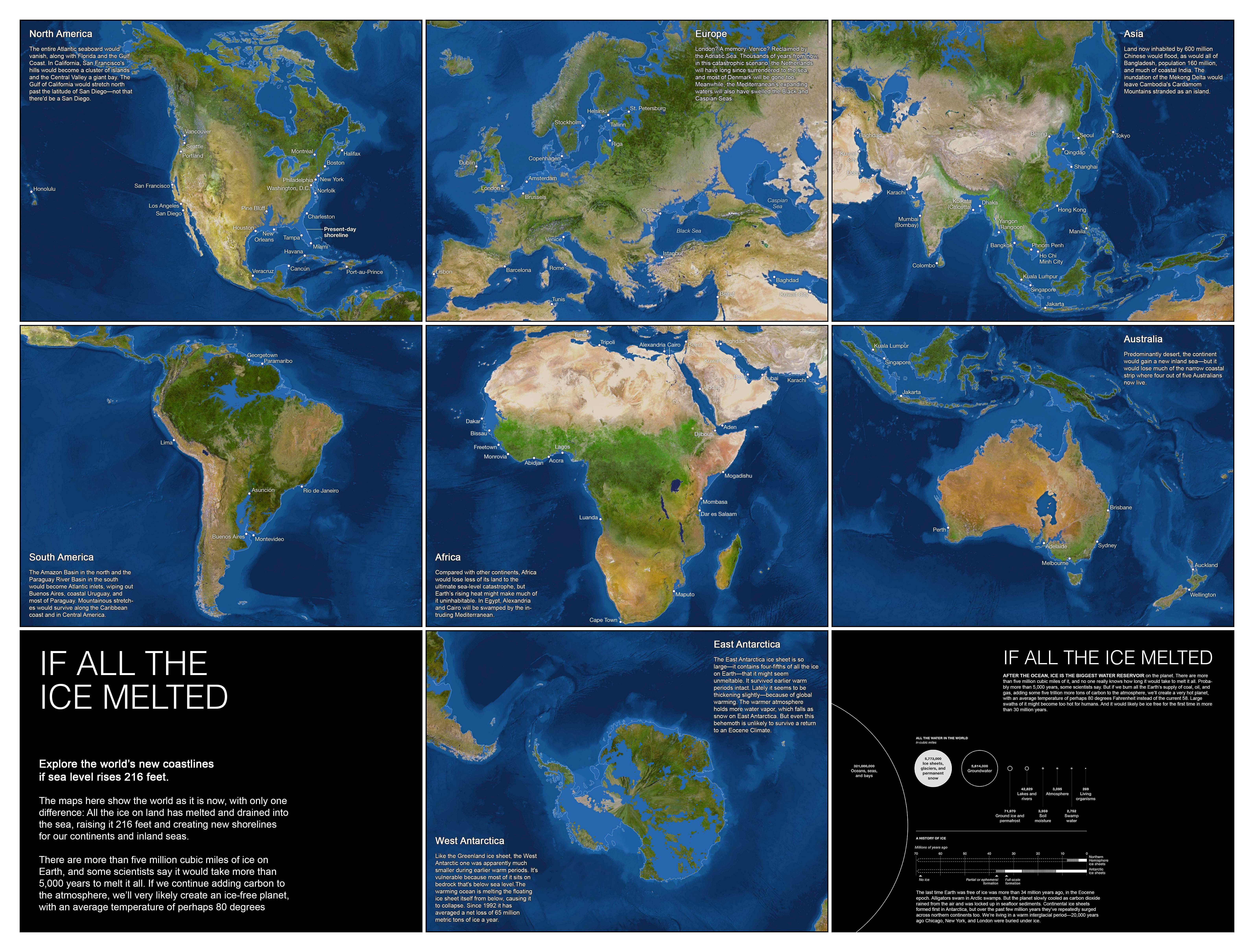 That’s pretty much all of the water available on Earth. 66m of sea level rise across the whole planet. I like hostile information. We have here a group incentivized to doomsday the worst possible scenario for world-wide flooding. They’re going to find absolutely ALL the water available to make their point. This is exactly the information I want, just… not for their purpose. Which is what makes it perfect. That lower right square has a nice breakdown of what’s available and where.
How much water is necessary to cover all of earth to Everest + 7m?
We already have the world filled up to sea level, so we don’t need to worry about that. Radius of the earth is 6371000m. Volume of a sphere formula is 4/3 π r^3^. Then repeat with + 8857. 1.08770x10^21^ m^3^ - 1.08321x10^21^ m^3^ = 4.59x10^18^ m^3^ of volume that must be filled. That’s 4.59x10^21^ L . Bolded because that number is getting used a lot. 1 liter of water is also 1 kilogram. We also should consider the terrain isn’t flat, we don’t actually need to fill that entire volume. The above sea level rock volume is about 8 x 10^8^ L. The way exponent math works the first digit that would be 13 places to the right of the decimal point and we’re working with only 3 significant figures here. That 9 does not change to an 8. If you think about it this makes sense. Commercial aircraft cruise at 9400m-11600m. Most of what’s below you at all times is a lot of air. Now… that’s all water. Note that low altitude is about 1km above our new surface level. About half a mile. We’re filling up the Earth to nearly aircraft cruising height. Contemplate that scale for a minute.
6.37x10^6^m is the mean radius of Earth. That’s calculated as mean of sea level at poles vs sea level equatorially. The Earth is an oblong spheroid, not really a perfect sphere. To simplify things for a calculation like this the mean is the correct value to use. Calculating the shell to get the exact precise number won’t change the magnitude of what’s going to happen here.
Mass of Earth is 5.97x10^24^ kg, 10^21^ is trivial enough so doesn’t change gravitation or orbit of moon. It does budge g (9.8 m/s^2^) but not enough to matter. I did calculate this and depending on how you approach it, the added radius cancels out the additional mass or it increases g on the surface of the earth by 0.03 m/s^2^. The variance of g across the surface of the Earth due to changes in density and lumpiness is about that much and none of us notice that. Wikipedia Gravity of Earth There’s a nice gravity map from the GRACE mission on there.
Let’s make it rain! 40 days and 40 nights!
8860m of rainfall over the next 960 hours over the entire surface of the earth will need to accumulate. 9.230 m of rain per hour. A violent shower is 50mm per hour, this is 9230mm per hour. 185x greater. The heaviest rainfall ever measured was 400mm per hour during cyclones, this is 23 times that.
9.230 meters of water needs to accumulate on every square meter of the surface every hour, so 9.230 m^3^/hr. There is 1000 L per m^3^ for 9230 L/hr. 1hr is 60min is 1min/60sec so 2.59 L/sec. One liter of water is 1 kilogram so 2.59 kg/sec falling on every square meter of the Earth’s surface. A water balloon weighs about 50g, so 51-52 water balloons hitting every second, everywhere on Earth. Large drops tend to break up into smaller drops that move slower, so that might make it marginally better as they’ll likely be regular giant drops but 23x as dense coming through that volume of space as anyone on Earth has ever experienced. Good news is it’s only about 0.2% of the volume of every cubic meter of air so it’s not completely displacing the atmosphere all at once.
Having the rain fall evenly over the entire surface is the best case scenario. If we were to dry up sections the rate of fall has to increase elsewhere to make up for where it was lost somewhere else. We’re already at 23x the worst rainfall flux that has ever been recorded.
That’s pretty extreme but doesn’t seem impossible…
So, there are consequences to all of this. Physical bills that must be paid. Energy and matter that must be accounted for. Unintended side effects due to the laws of nature. Natural observed phenomenon will be considered. Key is the scales involved most people (nearly all) have absolutely no reference frame for. Our planet is difficult to comprehend large with unimaginable amounts of mass when compared to the scale of a human, or even all of the people on Earth (also has become a difficult to contemplate number). 10^21^ is every person on Earth (10^9^) having the entire budget of the United States government (10^12^). 10^21^ seconds is 10 thousand times (10^4^) longer than the Earth has existed (10^17^). That is, the entire history of Earth… 10 thousand times. Scale. On the scale of the Solar System the Earth is nothing. On the scale of the Milky Way, not even a grain of sand (the Sun itself barely qualifies)… yet… the Earth alone is difficult to comprehend large.
The slice on which you live is incredibly small. The slice of energies you can survive not even a puff as far as the Universe, or even a planet is concerned. The planet winks and you die. The temperature range you can survive is incredibly narrow. You get about 250°K to 325°K in a Universe that operates 4°K to 30,000°K and beyond. Scale of The Universe - The Largest Star in the Universe Kurzgesagt
Note too there is a relevant XKCD (2501)

I know a lot about a variety of scientific fields and physical phenomenon. I easily forget that this isn’t typical or even normal. Knowing that the mass of a molecule reduces ever so slightly when energy is released during a reaction. Anything with temperature glows. That glows includes radio waves, microwave, infrared, x-rays, gamma rays; because its all light. That all materials have a specific value of how much energy it takes to raise its temperature 1°C. For liquid water it’s 4.184 J/g and it’s different for vapor and ice. And that it’s incredibly high, as most metals are around 0.4 J/g. All of the below are things like that. To me they are very normal and I think everyone knows them or has been exposed to them. For most people, this might be the first time they’re hearing of any of it. All of these things can be looked up and are explained in exquisite detail written by people who know even more about it.
Where does all the water to come from?
There is only 2.39x10^19^ kg in the ice caps to use. That’s pretty much all of the available water on Earth available to use for this purpose. Leaving 4.56x10^21^ kg to come from somewhere.
Option A - Create it out of “thin air”
E=mc^2^ says we can create matter from energy, to make 4.56x10^21^ kg of water. 4.56x10^21^ x (3.00x10^8^) ^2^ = 4.10x10^38^ J total minimum as it assumes a perfect 1:1 conversion ratio. 960 hours to make it (3.46x10^6^ seconds), 1.18x10^32^ J/sec (Watt). The sun puts out 3.86x10^26^ watts, so, we’re going to need a much bigger star and then Dyson sphere it. You would need a spectral class B star, 3-4 times the mass of our sun. That… will mess with the planetary orbits quite severely… (I’m not going to calculate that). That mass also needs to come from somewhere. Not even getting into once you’re done with the mass energy conversion what that extra star’s output will do to rise the temperature of the surface of the Earth. One could make all that water at a B class star and bring it here through interplanetary space. Regulus is the nearest one at 79 light years away. Maybe you could borrow it for a bit and drop that ice ball on the Earth… that’ll be a big hit as the trajectory will be hyperbolic in reference to the sun. You could use just about any star at that point as you’d have all the time you needed to make the mass of water then deliver it through interplanetary space at the correct time, but still have that hyperbolic orbit problem. This is also assuming you’d be using the energy of that star to fuel the energy input needed to eject your water-ice ball out of your originating system to send it to ours. I guess you could get really kerbal with it and basically make some kind of ice ship that elegantly shows down in orbit to deliver the water as gently as possible (below)… but understand you’re doing ancient aliens here.
I should note that humans don’t know how to do 1:1 energy to matter conversion. Closest we get is the production of anti-matter.
Option B - Comets
The other way to get that much water is to drop comets from the Oort cloud. Understand when I say “drop” I mean it quite literally. The entire Sol system is a big hill with Sol at the bottom and each of the planets as a divot. If you slow something out of its orbit it literally falls just as dropping a ball from your hand. Except the ground is the Sun and there’s no friction.
We will need to bring in sufficient number comets from beyond the orbit of the Kuiper Belt (Pluto’s orbit) to Earth to all arrive in that 40 day window. Not raining torrential rain drops, raining comets. Adjusting “high” orbits is pretty easy as far as rocket science goes. The orbital velocity far away from the gravitation center is slow, little changes in an orbital velocity vector has a huge effect on orbital parameters. The average Oort cloud comet is estimated to weigh 4x10^12^ kg. I initially considered transferring Saturn’s Rings (10^19^ kg), but there’s not enough ice there. The total mass of the Oort cloud is estimated to be at least a full earth mass (10^24^), up to 100 earth masses. Some estimates say there’s on the order of billions of comets (10^9^) and we need 10^21^kg. 12+9 is 21 so on those low ends we’ll be using most of the Oort Cloud. 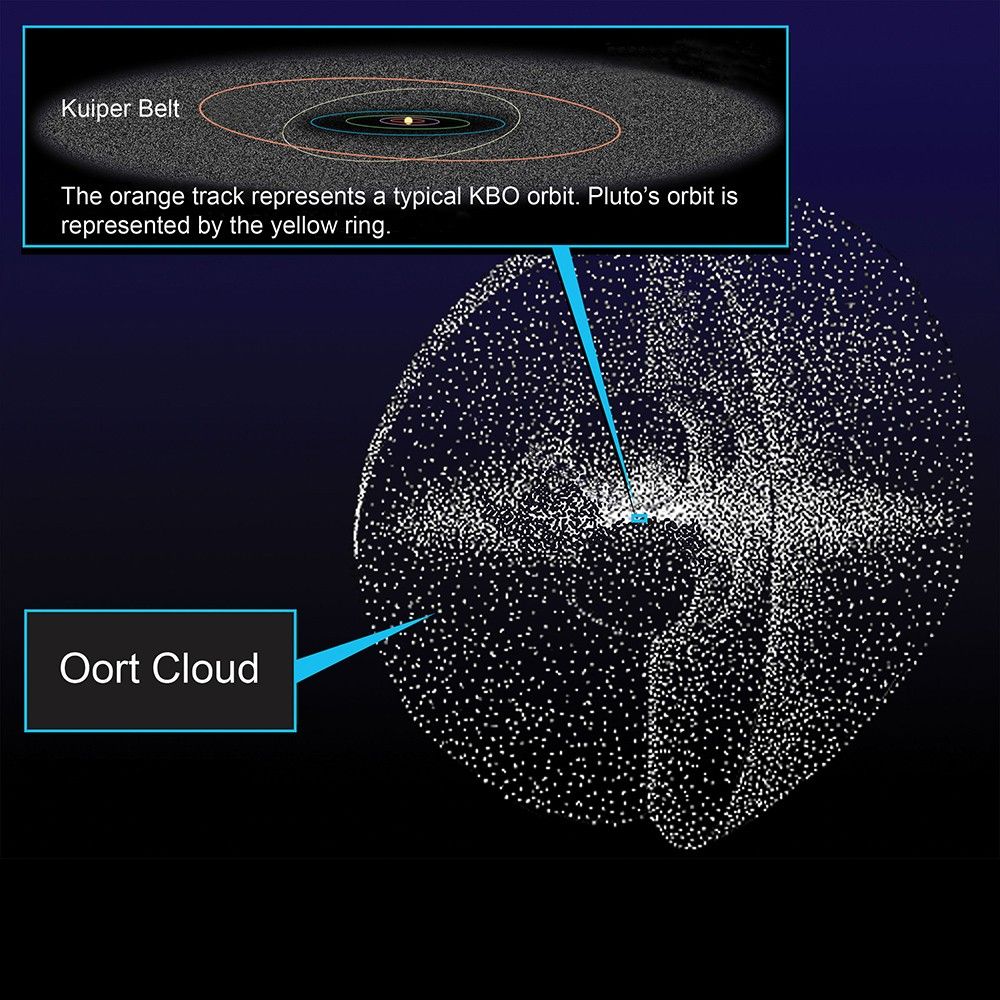

This average comet would be about 2km in diameter. Comets vary in their composition, but we’re going maximum charitable and saying that 100% of it is ice. It’s not. The size variance between comets will matter more. So averages. But it’s not going to matter much here and makes it worse… you’ll see. Dropping comets all in the same 40 days, provided you have time to set it up and years for the comets to make it in is astrophysics calculations. There’s many many ways to nudge those comets.
The Oort cloud is 2,000 to 100,000 AU (1 AU is the average mean distance between Earth & Sol). Our best case velocity will be one coming in from 2000 AU, arriving in plane, and will ever so slightly kiss Earth’s orbit at periapsis when the Earth is there… at 42.01 km/s, Earth is orbiting the Sun at 29.79 km/s. Delta of 13kms. Turns out no matter where you drop from in the Oort cloud the periapsis will sit at about 42 km/s. What changes is how much of the orbital velocity of the comet you need to cancel out in the cloud, it’s 200-400m/s. Note I’m assuming you’ll be able to find enough comets to arrive them in this best case way over the course of 40 days. I’m also completely ignoring the energy & reaction mass required to delete 200-400m/s of velocity from a billion ton object, and do that a billion times. Note it’s going to take years to decades for these comets to arrive. Once this course of events is set in motion it cannot be stopped. Orbit height and speed calculator
If the comet is out of plane (nearly all are), or need to arrive at a time other than the comet’s periapsis you’ll get closer to or possibly exceed that 42 km/s. Our best case has us at 3.38x10^20^ J of collision energy. The little boy dropped on Hiroshima was 6.3x10^13^ J. This single strike is 10 million times more energetic than that. The biggest nuclear weapon ever, Tsar Bomba, was 2.1x10^17^ J, this is 1000 of those all at once. The asteroid that wiped out the dinosaurs is estimated at 1x10^23^J, we’re 1000 times less bad than that - so good news there, except we need to do it a billion times over 40 days to get the amount of water we need. 290 of these strikes somewhere on Earth every second for the entirety of these 40 days. If 42km/s you go to 3.5x10^23^J, so now we’re at 3x what killed off the dinosaurs - for one collision. We could use smaller sized comets so atmospheric heating would disperse them some more before they strike, could even aerobrake them and bring them in over time, but that won’t happen over a month. Impact Energy Calculator
Because we’re bringing in billions to hundreds of billions of comets in a short time we’d heat the atmosphere incredibly. Remember the energy of the high part of the comet’s orbit has to go somewhere. In this case, it’s our atmosphere and the rocks or water the comet impacts. It’s the sort of event that would absolutely be noticed. The last time around this much water was delivered to Earth by comets, over a much much longer period of time (hundreds of millions of years - The late heavy bombardment 4 billion years ago, it kept the Earth entirely molten until the deliveries ceased. This would change our initial calculations for how much water we need as the surface of the Earth would look very different after this was finished… and molten.
Option B Two - Comets destroyed into a perfect tubular ice cloud exactly in the way of Earth to get this done
Even if performed in the most elegant way possible… say setting up a wall of comet tail debris such as the Earth plowed through it and picked up all the water necessary, you’d still have crazy meteor showers for the entire duration as… comets aren’t 100% water and the Earth would be plowing through a billion, trillion kg of water-ice. The shape of the ice field is extremely improbable and we’re glossing over the fact of how it arrived at this place, with what energies, and by what process. The energy of those collisions still applies. You may also be turning the atmosphere to a plasma. The Earth needs to acquire 4.78x10^18^ kg of water per hour, 1.34x10^15^ kg/second. This scenario is like we’re doing an atmospheric entry but with the Earth itself.
The Earth orbits at 29790 m/s so our 1.34x10^15^ kg of ice would need to be spread out over a volume of 3.80x10^18^ m^3^. This yields a density of 3.52x10^-7^ g/cm^3^. At far far less than .94 g/cm^3^ it means we’re not hitting a solid wall of ice. Just wanted to make sure.
The atmosphere still heats due to this flux of matter colliding with it. Downside to doing the calculation of water accumulation this way means that you have the full 29.79 km/s delta with all that ice. Perdue’s Impact Calculator is saying a projectile with the diameter of the Earth, with the density of our cloud, at a 90 degree angle, doing 30km/s will have 1.72x10^27^ J of energy. That’s happening every second. Neat part about their calculator is it’s on a slider so even if I drop it to 11 km/s it only helps by a single order of magnitude same if one moves the angles. The problem is the amount of matter! Every second means that joules is actually watts. The Earth’s surface receives 1.73x10^17^ W from the Sun over the same area. This is 10 billion times more.
The atmosphere is mostly nitrogen, and weighs 5.20x10^18^kg. Using the Watts to Heat Calculator setting it Nitrogen for a constant volume…The temperature of the atmosphere will rise by about 0.5-0.8 degrees Fahrenheit every second for the entirety of the 40 days. Except the atmosphere keeps getting heavier so each subsequent kg has less of an effect to the ones prior. But you’ll also be messing with a bunch of values as the entire atmosphere shifts its chemistry to being predominantly water rather than nitrogen. So, towards the end you’re going to be closer to 0.003°F per second. Even at that tiny number for the full 5 weeks it’s still 10,368°F. Iron Melts at around 2800°F. Iron boils… boils at 5182°F. Boils. Becomes vapor. At half the projected worst case here (ignoring a lot of stuff granted… IRON BOILING!). Note I’m using °F here as a kindness as most Americans relate to it and what it means a lot better than °C.
Still sounding like loss of the atmosphere kind of heating as it turns to a plasma and starts to interact with the solar wind and magnetic field. Or, the 10x Venus scenario from below…
I approached this a different way initially with the heating flux of the 290 impacts every second heating the atmosphere and came up with very similar numbers. Two different approaches, similar result, probably something to consider.
Probably the craziest part of the consequences of the above is simply delivering the water in this way would reboot all of the rocks on the Earth to a great depth. All rocks would become new basement rocks. All new mineralization and chemistries would occur. There would be no limestones remaining as they could not exist through this catastrophe no matter how it was done. There would be a geologic scar of this reboot everywhere on Earth. Every bit of geologic information before this event would be erased everywhere. Kind of like the last time it happened… The late heavy bombardment, same link as above Or when Theia collided with proto-Earth and formed the Moon (and probably our core)
Okay we destroyed the world. How about we pop the water into, and out of, existence without all that pesky planetary scale energy physics involved? Can we do Option C - Magic?
Heat of Vaporization/Condensation
All of that water vapor freezing to become rain releases heat into the atmosphere 40.7 kJ/mol when it becomes liquid and another 6 kJ/mol when it freezes. 6 kJ/mol is released when the ice is formed high in the atmosphere and re-absorbed when it melts to become a raindrop. Net zero, so we can ignore the 6 kJ/mol. That 40.7 kJ/mol should be accounted for. A mol of water is 18.0g, or 0.0180kg. A mol is the atomic mass of a substance in grams; in a mol there are 6.02x10^23^ molecules of the substance in question.
First accounting should be how much total energy is released per second by this process. 2.59 kg/sec/m^2^ would be 144 mol/sec/m^2^ for 5860 kJ/sec/m^2^. 1 Watt is a joule per second, 5860000 J/sec/m^2^, 5.86x10^6^ W/m^2^. The surface of Earth is 5.1x10^8^ km^2^, so 5.1x10^11^m^2^. 2.99x10^18^ W total. The Earth receives in the upper atmosphere about 1.75x10^17^ W of energy from the Sun total. We are at about 20 times that.
Enthalpy of fusion & vaporization a mechanism the universe uses to control the phase of substances as a bulk. It’s a key part of equilibrium and keeping molecules “on the same page” about which phase they’re mostly supposed to exist. It’s an emergent property of energy conservation between colliding individual molecules. In this case so much heat is being released with nowhere to go that an equilibrium would be reached where no more rain can form. The heat of condensation would overwhelm the heat of vaporization and the water would go right back into vapor. No net energy released. This is why boiling-condensation-freezing are temperature and pressure dependent. If we ignore this and keep pumping in the mass of water necessary eventually the water will start condensing again per the water phase diagram (linked later). Water just keeps condensing because it must due to the pressure and the Earth would need to radiate off (via light) 20x the energy it is receiving from the sun to stay the same temperature. Caveat is as you increase temperature and pressure the enthalpy of vaporization changes, calculating this of off this hypothetical is not something I’m going to do because it’s going to require calculus and if we’re to this point it’s details as everything multicellular is very dead and we’re into bonkers exotic chemistry territory. Enthalpy of Vaporization
Using the Stefan-Boltzman black body law with .95 for emissivity (the average for Earth), we’ll use the surface area of a sphere at 100km (well above the mesosphere, but below the ISS) for the emission surface 5.26x10^14^ m^2^… Which has the Earth glowing at 562.7°K, wavelength at peak spectral radiance 5150 nm which is deep in the infrared (red visible light starts at 700nm). Even breaking the rules it’s not too crazy here. Though it should be noted that 562.7°K is 289.55°C is 553.19°F. Right now the upper atmosphere at that altitude is -95°C. I just so happened to have picked the cold spot to dump all of the energy from condensing the rain. This is serendipitous because we needed somewhere cold for the energy to go. Making this cold spot almost 400°C hotter is probably not good though. Higher in the atmosphere where the energy is received from the sun it gets 500°C-1000°C and that is transmitted downward via conduction.
In these domains “temperature” is misleading because the number of molecules carrying the energy is very small. Remember this altitude is well above the ISS. You’d need a space suit. Temperature is actually a measure of the average kinetic energy of the molecules in question. As they bounce off of each other they transmit some of their energy to whatever they hit, averaging it out, thus thermal conduction. “Space” isn’t really good enough of an answer as to where to dump heat. Space is nothing, it’s not cold, it’s nothing. So you can only dissipate heat into space via electromagnetic radiation (photons). The way we’re used to moving heat in our personal experience is by thermal contact, molecules touching each other. Conduction & Convection. All of this is actually a good thing because if space was able to be used as a cold sink as in our common experience, the Earth would be frozen and dead unable to retain its heat. The Earth is insulated thermally by space itself. Stefan-Boltzman Law - Blackbody Radiation - Layers of the Atmosphere
Water Vapor
Adding this much water to the atmosphere will too have consequences. Currently there is 1.29x10^16^ kg of water in the atmosphere. Throughout the atmosphere it varies between 0% and 4%. On average about 0.25% of the total composition. The atmosphere itself is 5.148x10^18^ kg. We’re adding 10^21^kg, so a thousand times more mass than the entire current atmosphere. The atmosphere basically becomes entirely H~2~O at this point. Normal air pressure is 0.101 MPa. Increasing the mass of the atmosphere by 1000 would mean… 101 MPa. We went to 1000 standard atmospheres. Venus is only 92 atmospheres. So about 10x Venus.
 If you look at the phase diagram for water you’ll see that above 22MPa water cannot exist as vapor. Good news because that means that’s the maximum possible pressure of our atmosphere here, and where the equilibrium will go. 217 atmospheres so double Venus. In this case that heat of condensation is required so that 562 Kelvin thing is probably happening. Looking at the phase diagram that means we’ll probably settle in around 10Mpa, getting us to regular Venus until things cool down. Which will take a very very long time.
Something to point out: beyond that critical point water becomes a phase called a supercritical fluid, it’s kind of like both liquid and gas simultaneously with special properties. As long as both pressure and temperature of the critical point are exceeded, it will exist as a supercritical fluid. We are actually playing in that territory. If assumptions made about the heat of condensation are different, or other physical processes raise the temperature by about 100 °K… the atmosphere and probably a lot of the ocean would become a supercritical fluid. In this context and scale 100°K is not very much, it’s very possible. Yes, as the critical point is approached the enthalpy of vaporization drops so the heat per mole given off will also drop. We’re taking 1000 atmospheres and turning it into 217 and seriously talking about reaching the critical point of water. These are details at this point. We’re describing how much of an ultra Venus we’re getting. The Earth being habitable at all by anything resembling common life now is completely off the table. The surface of Venus exhibits supercritical CO~2~. Some of the hot smokers deep in the oceans of Earth at hydrothermal vents are super critical as they breach into the ocean and are certainly critical right below. Supercritical Fluid - Beebe Hydrothermal Vent Field - Wikipedia
Even here… I’m beyond where to even predict where this all would go or what calculation to do. I don’t know how much would precipitate, how much the equilibriums would shift, what would happen thermally as the energy brought with the mass of water would dominate this system. Can it occupy the space or do parts of the atmosphere blow off? How much does it increase the physical thickness of the atmosphere? If the water comes in at absolute zero something different would happen than if it comes in as vapor. I’m assuming vapor because of the requirement that it rains. If it comes in from space it is going to start as vapor after entry energies. Does bonkers chemistry happen that moves things around in unexpected ways? The whole thing is bonkers. The fact that the atmosphere becoming a supercritical fluid is legitimately in play is proof. This equilibrium would likely take thousands to hundreds of thousands of years to establish. Where the water comes from and what temperature it is at would matter to know how much energy is being brought into the system that must be dealt with. Putting 4x the current Earth’s ocean’s mass of water straight into the atmosphere suddenly so it can rain it down over the course of 5 weeks is probably a bad idea if you want complex life to make a quick comeback.
Don’t forget while all this is happening the Sun is still adding 1000W per square meter across the entire day-time side of the planet. A planet now with an atmosphere dominated by water vapor rather than nitrogen.
I didn’t approach this using the specific heat of water because ice, liquid water, water vapor, and super critical water all have different specific heats. Super critical water’s specific heat is actually dependent on pressure and temperature. That makes calculating what might happen in the bulk extremely difficult via this route. In this system likely all would exist (except maybe ice, but only maybe we’re at very high pressures here). Water - Ice
Salt
All of the water on Earth is 1.39x10^21^ L. The ocean has 35g salt/Liter on average. High of about 38ppm, low 32ppm. Ocean life requires this.
We’re adding 4.59x10^21^ L of fresh water to the planet doing more magic so the planetary scale energies are not in play and it magically rains normally 23x harder everywhere than it has anywhere as long as humans have been around, without Venus consequences. The salt in the ocean is going to dilute across that because it doesn’t rain salt water. That rain will be punishing so I’m going to assume some pretty solid mixing forces. Finally some easy math as both are 10^21^. The ocean is now 5.98x10^21^L, we’ve increased the mass and volume by 4.3x which means that salinity is now 4.3x lower so now 8.14 g/L or ppm. This is going to collapse the biosphere in the ocean. It’s too salty for freshwater life, not salty enough for ocean life. This is a problem on a cellular level for most aquatic life due to how they maintain water volume in their cells, move nutrients across their membranes, and some surface protein function. Some animals like bull sharks may handle this, but the plants, phytoplankton, zooplankton, and on and on will not. By flooding the whole earth in this violent way every animal and plant on land is also dead. I had the thought that some kelps, mosses, algae that survive in brackish waters might be fine, but now they are 8500+ meters down. They also live in these habitats because of high nutrient density and access to the sun; they require it. 8500m down is absolutely black black, no light penetrates at all (especially infrared). We didn’t just dilute the salt by 4.3x, we diluted everything, that nutrient density is gone. Maybe the critters down by the black smokers won’t mind except you doubled the pressure where they live, so that supercriticality thing is easier to reach. That’s probably not good.
Let’s go the other way, we’ll pop the mass of salt required into existence too knowing full well all of the planet ending consequences of moving or creating these kinds of scales of matter. I don’t even know a simple, easy place to find that much ionic salt. Or sodium, potassium, chlorine, bromine… drop asteroids? If the current oceans were were removed and the salt placed evenly across the surface of Earth it would cover the entire area with a layer over 500 feet thick, it’s a lot of salt. 50 quintillion kilograms (5.0x10^19^kg). We need 4.3x that amount, 2.15x10^20^kg. Pretty nuts that we need an order of magnitude less mass in salt than we do water. When the waters subside (magically the water also pops out of existence because all of the world melting energies also apply to getting rid of it), the salt will stay dissolved up to 26.3% (the ocean is about 3.5%). Multiply 3.5% by 4 and you get 14%… which means… everything dies. And when I say everything dies, I mean you’ve collapsed the biosphere either way you go and the animals on the Ark too are going to have a bad bad time. Most of the oxygen cycle is due to the phytoplankton blooms in the oceans. All of them are dead. Or we’re doing magic and popping the salt and water both in and out of existence too even more violating a key, foundational law of physics (Conservation of Mass & Energy). The situation is staying this way for 5 weeks. Nothing is going to tolerate this salinity, lack of nutrients, or pressure situation for that period of time no matter how you magic the matter.
We’re not even getting into what this will do to the gasses dissolved in the oceans (and atmosphere). Life with mitochondria need oxygen. Does all the sudden added fresh water pull enough oxygen out of the atmosphere to the point Noah and the critters suffocate? To figure that out it would be necessary to know exactly what’s happening with the salinity and temperature situation. This being on the table - not good.
This is such a huge scale of matter we couldn’t help but to notice it. I’ve heard “it goes into the mantle”. Under the crust isn’t a magic disappearance zone, it also has chemistry and physics going on that is measurable. Neither that mass of salt or water is there, certainly not both. We already accounted for all of the water bound up in the rocks and reactions to make specific minerals. In this case the mass of the ocean was multiplied by a factor of about 4; it would be hard to miss it.
Remember that bit about enthalpy of condensation? It applies here too it’s called the enthalpy of dissolution. This actually goes the other way where the salt absorbs energy as it dissolves, about 3.88 kJ/mol. 58.44 g/mol for sodium chloride. Accounting for Iodine, Bromine, Potassium, etc in the right amounts doesn’t really change things much. 3.68x10^21^ kJ needs to be absorbed by the salt to dissolve. Which is cool because that negates 10 of the billions of comet strikes. Or about 1000 seconds (about 16.6 minutes) of the energy released from the condensing rain. Too bad it’s raining for three and a half million seconds.
The cArBoNaTeS…
As pressure increases calcium carbonate becomes more soluble. We’ve reduced the salinity of the ocean severely but it’s not enough to overwhelm this kind of pressure. More salinity means calcium carbonate is even more soluble. Calcium carbonate cannot remain solid under these pressures unless you heavily, heavily saturate the solution. To the point that if an ocean critter with a shell dies above the Marianas trench in our current ocean and sinks, the shell will dissolve and disappear before it reaches the ocean floor. Not due to acid, due to pressure. The consequences of “okay, let’s do this” is a whole other string of catastrophic math & consequences similar to adding enough salt to not mess with the salinity of the ocean. Only this time it would be carbon dioxide gas. Do we need to talk about mega Venus again? Do we need to talk about how carbonates and silicates are even MORE soluble in supercritical water? Pressure is the reason carbonates for limestone deposition are formed in shallow seas, shallow seas are low pressure. Freshwater is even better at forming limestone because calcium carbonate can sometimes precipitate out on its own. See caves with stalactites & stalagmites all over the world.
Nearly all of the limestone on earth was formed due to something once alive. Yes, nearly all of it was formed by dead lifeforms. To make limestone you need dead animals to precipitate themselves and their shells & skeletons over geologic time, grind them up into sand, then for those shallow seas to recede. Sometimes dissolve them and re-deposit them, repeatedly. The nature of a given limestone shows its history. The marine snow/silt/graveyard needs to have about a kilometer of solid stuff above it (generally more dead things) for about a million years to compactify and lithify. Chemically welding these sand grains via chemical process and pressure, but not to metamorphic levels, similar to setting concrete but more complete. Limestone compacted to metamorphic levels is marble. Making limestone also takes a minimum of 100,000 years. These quickly formed limestones we know didn’t have enough time as they have very large pore-sizes. Mankind has tried to make our own limestone but we can only get to about 40MPa in the conditions needed and our pore sizes are about 20x the size seen in nature. Mass must be conserved. To make that much limestone that incredible mass of animals (ideally with shells) needs to live to grow their bodies and die. This is only reasonable if it’s happening over hundreds of thousands to millions of years. Otherwise you have all the necessary mass of life-forms harvesting energy (chemical/food, solar), nutrients (calcium, carbon, and oxygen), and occupying the same space at the same time trying to do whatever it is they do. Limestone
 Here’s an estimate of exactly how much life I’m talking about. A nautilus weighs about a kilogram. Let’s assume they are about half of a sphere with them commonly being .13m in radius. That would mean it takes up 0.035 m^3^. There’s estimated 6.65x10^20^kg of limestone on Earth meaning we’ll need that many nautiluses. Our starting ocean volume 1.37x10^18^ m^3^ as they would have had to be there before the 40 days as it takes a lot longer than that to grow a nautilus. 0.035 m^3^ x 6.65x10^20^ / 1.37x10^18^ Each nautilus gets 17 cubic meters of ocean. Cube root of 17 is 2.57. So every 2.57 meters roughly there is another nautilus. Lattice of nautiluses through the whole ocean.
Marianas trench pressure about 110 MPa at 10984m depth. Conveniently we’ll get roughly that on the current surface. 250 MPa under soil/rock/stone required to make proper limestone some types require occasional intrusion of fresh water (not salty), but it must be cyclical. Supercritical water turns out to play a role in rock formation deep in the crust and the mantle. A little bit (not the entire ocean and atmosphere!) will solvate then redeposit the carbonates in order to assist in compaction. With what we know about the mantle and deep crust, of course water exists as a supercritical fluid there. A big part of limestone formation is squeezing out water and filling in voids. And, you have about half the needed pressure anyway. Even at the Trench during this hypothetical flood now 20km under water you still are at 200MPa, not enough. The heat isn’t either unless we’re doing the Venus scenario. Still not quite enough pressure for something else cool to happen… exotic ice. About -25C, 210MPa Ice III forms (normal ice is Ice Ih). We bring in that phase diagram for water again. Phases of Ice
Conclusion
In all of the above it was only the water showing up and being present. You’d have to get rid of it too so the current amount of water on Earth we observe is correct. You need similar energies to get rid of it, and it would need to go somewhere we can’t find it, so it would require even more energy. Similar levels of energy to popping it into existence would be released when you popped it out. Or you’d need incredible launch energies (where’s that coming from?) to put all that water back in some kind of solar orbit, how high and by what mechanism? I know of none.
Note too that all of the above I was reasonably careful to stay with Watts per area so both space both space and time were considered at once. The reason why is global energy consumption is about 2x10^18^ J/day around 10 nuclear bombs per day. But that’s distributed everywhere and over 86400 seconds. We receive a nuclear bomb’s worth of energy every second from the Sun, distributed over half of the atmosphere. Above we were talking about over all of the atmosphere intaking 10x-10,000x what the sun drops on it per second. That’s a very different thing. It’s easy to write alarming things when about normal things when you don’t account for space and time simultaneously. Except I did.
As physical laws were broken to show the absurdity of even one of them applying, understand in the actual Universe ALL of them do. Simultaneously. Many would have combined effects. It wouldn’t be making anything better or avoid completely bonkers water world ultra Venus.
Understand all of the above shows it didn’t happen because it can’t.
The Universe is never wrong and the Universe never lies. The laws are the same as they have always been because there is no law that demands they change. Whatever the Universe tells you directly is correct. If your hypothesis, belief, even theory contradicts a measurement or result that pops out of the Universe directly; you are wrong. Your understanding is incomplete at best and entirely possibly simply incorrect. I expect I’m wrong. I expect there’s something I’m not considering, as I’ve found many in writing this. But not 10+ orders of magnitude of not considering.