
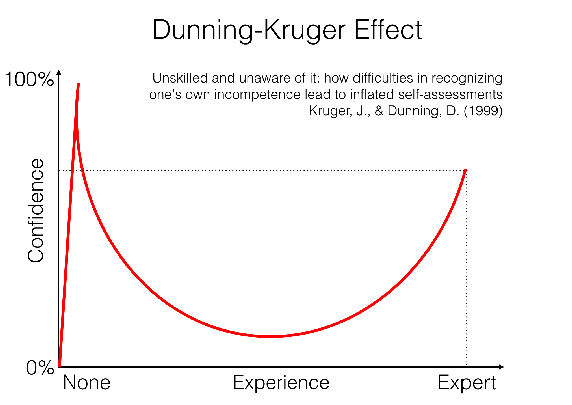
The Dunning-Kruger effect, essentially, is the less someone knows about a topic the more competent and capable they think they are in regards to it. That person massively over estimates their abilities in that area. Often extreme confidence is a sign of extreme incompetence. Experts tend to underestimate their knowledge and abilities. Knowing about Dunning-Kruger though often leads someone to the contrary effect that is impostor syndrome. This is especially the case in the propaganda environment we find ourselves. Some expert employed with some agency or university knows better than you, that you possibly cannot know because you don’t hold the correct title, correct job, correct history - when in fact you can know and maybe do. It somewhat explains the situation we find ourselves in this very day. Otherwise very smart people and that know better are under the effect of this phenomenon. They, as true experts, are receiving information from on high and thinking their questioning of it just shows they don’t really know enough. In fact this questioning is correct but is being dismissed by the expert, because someone is more expert. They acquiesce to social pressure in order to not be discovered as an impostor. But they are not an impostor.
In researching the Dunning-Kruger effect it was found that many Nobel Prize recipients in science believe themselves impostors. Many don’t feel joy when informed they are informed they will receive the Prize, but dread because they believe they are about to be discovered as an enormous fraud. The interesting lesson here for us: these doubts are a hint that you’re probably on the correct path and need more confidence in your knowledge and abilities. On the image above you’re probably in the trough provided you’re not before the know-nothing overconfidence spike. Having no doubts about where you sit probably means you’re on the left side of that graph. Notice confidence never reaches 100% even at full expertise, and full expertise can never be attained.
Once one reaches a certain level of competence, even somewhat advanced knowledge seems basic. This causes an expert to have a difficult time determining exactly where a novice resides in relation to them and other people in between. There becomes a problem too of not wanting to share knowledge for a general audience thinking that it is too hard and won’t be and cannot be understood. There’s a desire to make the knowledge arcane in order to make it harder to comprehend. There’s some protectionism here too. Too many hierarchies of expertise start to look like fraternities and religions with clergy and secret knowledge that must be protected in order to maintain the authority of the organization. Truth is, humanity isn’t actually very advanced and the 80/20 distribution applies. You can without too much difficulty know 80% of whatever you like, maybe even 90% and that makes you quite serviceable in the field. What it takes is the confidence you can and to not listen to people saying that you cannot. They’re thinking you have to be at 99% to be an expert, you do not, they even are not. There’s a lot of societal pressure to prevent people from learning medicine, physics, chemistry, literature, history, etc. It’s always pushed you’re not being rigorous enough, too big picture of a view, not covering this certain niche, etc. The real result is to get you to do nothing rather than better yourself without paying them.
My opinion is titles are a problem. Lots of people throw down “I was xyz superspeed operator with qfy unit”, that’s cool, you might know things. You might be a horrible teacher, skated by and didn’t retain anything you were taught. Somehow may have even avoided the key training or evaluations and that’s how membership in the unit was retained. Whereas you have another person that never served in the military but dedicated themselves to the study of the martial art, retained and refined their techniques and is superior to the first guy in every technical way, even remembering where they came from and how they learned what they know. Yet, second guy will be told he is a poser and an impostor, and to stay in his lane even though he is objectively better. Due to the lack of the title he is very able to make the case as is practiced at it. We allow titles to stand in for making the case. Incompetence shows up very very quickly when you force someone to make the case rather than rest on their titles. It might be wise to demand this of others in all things. Teach me, make the case, show me you actually know more. No more “trust me, I was operator in xyz cool sounding special forces unit” or “I am director of medicine at QQF Hospital”. Good. Then making the case without relying on your title will be trivial.
I’m encouraging you to become a Renaissance man. Learn what you want to learn. Know what you want to know because you want to know it. Take training, or do it on your own. Be introspective about what you do know, but keep in mind the outside actors trying to keep you down. Keep in mind Dunning-Kruger and the Imposter Syndrome simultaneously. Become better than you were yesterday. Do things you could not the day before, know more than your previous self. Don’t let people tell you you’re not good enough. Be willing to shut people down when they are saying nonsensical things. Their titles don’t grant them a pass from reality.
Keep walking the Path, learn the Way.